Vishwakarma
विश्वकर्मा
The Celestial Engineer — Architect of Impossible Worlds, Inventor of the Divine Machines
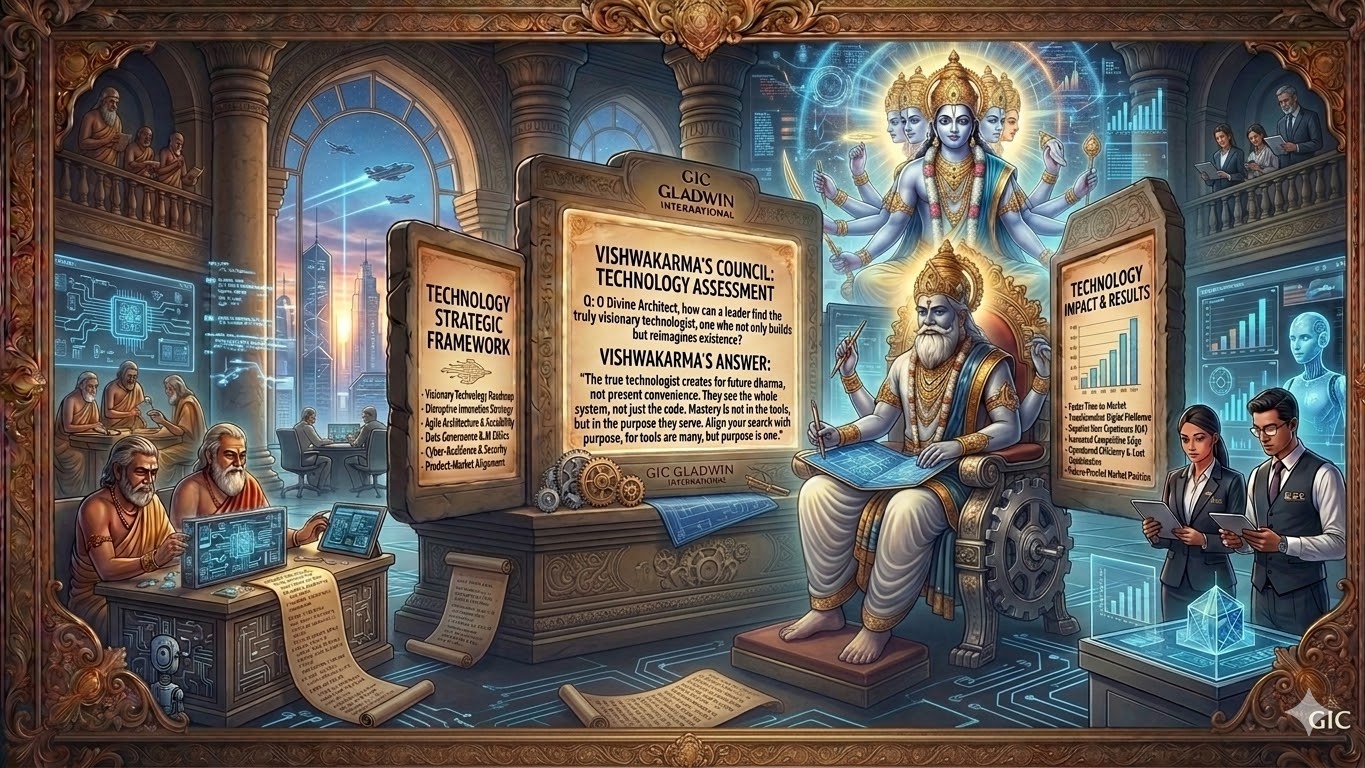
The Artwork — Vishwakarma bends over his celestial drafting table in the workshop of the gods — the blueprints of Dwaraka, the Pushpaka Vimana, and the Sudarshana Chakra spread before him. Around him, the tools of divine engineering glow with sacred light: compasses, forge-hammers, architect's squares made of starlight. Above, the gods queue patiently — each awaiting the impossible thing only he can build.
Vishwakarma did not wait for specifications. He imagined what had never existed, architected it with mathematical precision, and built it in a single act of concentrated genius. Every great technology leader is asked, in some form, to do the same thing: to build the platform for a world that does not yet exist.
The Rigveda calls Vishwakarma 'Visvakarman' — the all-creating craftsman whose mind contains the blueprint of every possible thing. He is not merely an engineer; he is the principle of technological intelligence made divine. In him, imagination and execution are indistinguishable — he conceives and he builds in the same breath, and what he builds reshapes the order of the cosmos.
Among his most astonishing creations is the Pushpaka Vimana — the self-navigating aerial vehicle that flew by the power of thought, responding to the intention of its operator. Described in the Ramayana with extraordinary technical specificity — its propulsion, its navigation, its passenger accommodation — the Pushpaka Vimana is the world's first recorded vision of intelligent autonomous flight. Vishwakarma did not build a machine. He built a system that extended human agency across dimensions of space and time.
Then there is Dwaraka — the golden city built on land reclaimed from the sea in a single night. The engineering of Dwaraka was not merely architectural; it was a feat of systems integration. Sixteen thousand palaces, gardens, markets, temples, harbours, and defence fortifications — all designed simultaneously, all functional from the first day, all calibrated to Krishna's vision of what a civilisation should be. Vishwakarma did not just execute a brief. He interpreted a vision and gave it form that exceeded what was imagined.
But perhaps Vishwakarma's most enduring technological legacy is the Sthapathya Veda — the ancient science of architecture, engineering, and spatial design that he codified and transmitted as a teachable system. He understood that individual genius, however brilliant, is insufficient to advance civilisation. The knowledge must be structured, documented, and made transmissible — so that the craft outlasts the craftsman. He was not just an engineer; he was the world's first technology architect who understood the imperative of platform over product.
Today, every technology organisation in India invokes Vishwakarma on Vishwakarma Puja — not as a ritual of superstition but as an acknowledgement of something true: that the greatest technology is always, at its root, an act of imagination disciplined by engineering. The digital economy's greatest builders — of platforms, of AI systems, of cloud infrastructure, of product experiences that serve billions — are the Vishwakarmas of the modern age. They imagine what does not exist, architect it with precision, and build it fast enough to matter.
यः सर्वज्ञः सर्वविद्यस्य ज्ञानमयं तपः। तस्माद् एतद् ब्रह्म नाम रूपम् अन्नं च जायते।
Yaḥ sarvajñaḥ sarvavid yasya jñānamayaṃ tapaḥ. Tasmād etad brahma nāma rūpam annaṃ ca jāyate.
“He who is all-knowing, all-seeing, whose very discipline is made of knowledge — from him all names, all forms, all nourishment emerge into being.”
— Mundaka Upanishad · 1.1.9
The Four Pillars That Define the Great Technology Leader
Imagination as Engineering Discipline
Vishwakarma's genius was not unstructured creativity — it was imagination operating within the rigorous constraints of structural mechanics, material science, and functional purpose. The Pushpaka Vimana was not a fantasy; it was a precisely engineered system. The Maya Sabha was not an illusion; it was an architectural achievement so precise that it produced optical effects as a deliberate design outcome. In Vishwakarma's world, imagination and engineering were not opposites — they were the same activity at different scales.
The finest technology leaders do not separate vision from execution. They insist on both simultaneously: an architectural imagination bold enough to conceive platforms that do not yet exist, and an engineering discipline rigorous enough to build them reliably at scale. The greatest CTOs, CPOs, and technology CEOs are those whose product vision is always constrained by a clear-eyed understanding of what the engineering can actually deliver — and who push the engineering relentlessly toward what the vision requires.
Platform Over Product — The Sthapathya Imperative
Vishwakarma's most consequential contribution was not any single artefact but the Sthapathya Veda — the codified science of construction that survived him by millennia. He understood, intuitively, that the greatest technological achievement is the creation of a platform of knowledge that enables others to build. A product serves a moment; a platform serves an era.
The technology leaders who define decades — not just quarters — are those who build platforms rather than products, and systems rather than features. They architect for extensibility, for the builders who will come after them, for the use cases that do not yet exist. India's technology sector, in its most ambitious register — the UPI payments infrastructure, the Aadhaar identity stack, the cloud platforms of global hyperscalers — is a Sthapathya Veda for the digital economy: a system of systems, built not for a single purpose but as a foundation for infinite possibility.
Speed as a Moral Obligation
Dwaraka was built in a single night. Lanka was constructed before a deadline of cosmic consequence. Vishwakarma did not operate on the timelines of ordinary construction; he operated on the timelines that destiny required. His speed was not recklessness — it was mastery so complete that execution became instantaneous. The gap between vision and delivery closed to zero not because corners were cut but because preparation was total.
In the technology sector, speed is not merely competitive — it is moral. Moving slowly in a market where the window of opportunity opens and closes in months means that the people who needed the product go unserved; the problem that could have been solved remains unsolved; the organisation that could have led instead follows. The greatest technology leaders build cultures of velocity that are not chaotic but disciplined — where decisions are made quickly because the thinking has been done deeply, and where delivery is fast because the architecture was right.
The Craft of the Invisible — Systems That Disappear
The most remarkable thing about Vishwakarma's greatest creations is how effortlessly they functioned. The Pushpaka Vimana flew without visible mechanism. Dwaraka's infrastructure operated without evident maintenance. The Maya Sabha's illusions were so perfect they required no explanation. The mark of supreme craft, in the Vishwakarma tradition, was that the engineering became invisible — that the user experienced only the outcome, never the complexity that produced it.
The greatest technology products and platforms are those whose engineering complexity is entirely invisible to the user. The experience is simple, fluid, and magical — and the extraordinary technical architecture that makes it possible is never seen. This is the highest form of technology leadership: building systems so well engineered that they disappear into the fabric of daily life. The leaders who achieve this combine deep technical depth with an almost artistic sensitivity to human experience — the rarest and most valuable combination in the digital economy.
How We Search for Technology Leaders
Our Technology & Digital practice is among the most active and deeply networked in India's executive search landscape. We operate across the full technology ecosystem: India's IT services majors, product-led SaaS and platform companies, Global Capability Centres of Fortune 500 corporations, AI and machine learning ventures, semiconductor and deep-tech businesses, cybersecurity companies, and the infrastructure and cloud platforms that underpin the digital economy. We search for leaders who carry Vishwakarma's defining quality — the ability to architect the future before it is visible, and to build it with the precision and speed that makes vision consequential. We identify CTOs who can bridge deep engineering credibility with product and commercial vision, CEOs who combine technical fluency with organisational leadership, and CPOs who design experiences that make the complex feel effortless. In a sector that is simultaneously India's largest employer, its most significant foreign exchange earner, and the foundation of its digital sovereignty ambitions, we take this search with the full weight it deserves.
Vishwakarma's legend does not rest on what he built but on the fact that what he built changed what was possible. Dwaraka changed the geography of civilisation. The Pushpaka Vimana changed the definition of mobility. The Sthapathya Veda changed the transmission of knowledge across time. The technology leaders we seek carry exactly this ambition — not the ambition to build great companies, but the ambition to build things that change what is possible for the world.
Begin Your Technology Search
Every great Technology search starts with a conversation. Speak with our practice lead — confidentially, without obligation.
Related Industries