Kubera
कुबेर
The Lord of Wealth — Divine Treasurer, Guardian of the Northern Quarter, Keeper of the World's Riches
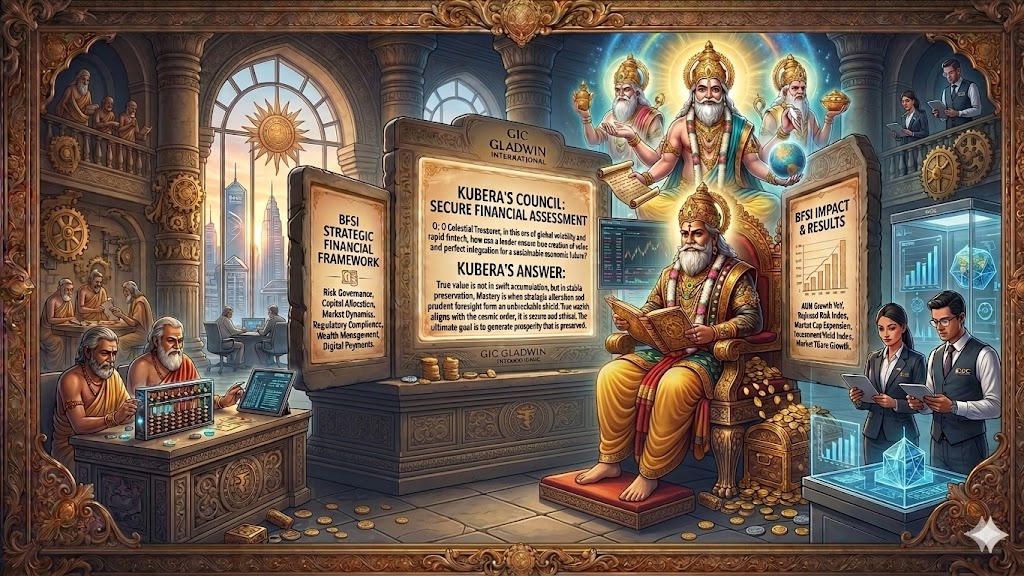
The Artwork — Kubera sits enthroned in his celestial palace of Alaka, surrounded by the nine treasures of the universe — Padma, Mahapadma, Shankha, Makara, Kachchhapa, Mukunda, Nanda, Nila, and Kharva. Before him, the ledgers of cosmic wealth are open; around him, the Yakshas who guard the world's riches stand vigilant. In one hand he holds the mace of authority; in the other, the purse of abundance — not for hoarding, but for governance.
Kubera was not wealthy because he was lucky. He was wealthy because he understood the dharma of wealth — that riches are not an end but an instrument; that the great treasurer's obligation is not to accumulate but to govern. The finest BFSI leaders carry exactly this understanding into every institution they lead.
In the Vedic cosmology, Kubera holds one of the most consequential offices in the universe: Lokapala of the North, guardian of one of the four cardinal directions, and Nidhi-pati — lord of the nine divine treasures that sustain the material world. He is not an improvised god of good fortune but a cosmic officer of extraordinary responsibility, appointed by Brahma himself to govern the distribution of wealth across all the realms of existence.
The Mahabharata tells us that Kubera's celestial city of Alaka — built by none other than Vishwakarma — was so magnificent that even the gods paused to admire it. It was a city of perpetual abundance, not because wealth flowed without effort but because it was governed with supreme precision. Kubera's Yakshas — his treasury guardians — were not passive custodians but active managers of the cosmic financial system, ensuring that resources moved where they were needed, that surpluses were stored with discipline, and that the system never collapsed under its own weight.
Yet the Puranas also record Kubera's great humbling. Seated in pride at his overflowing treasury, Kubera once invited Shiva and Parvati to a grand feast and boasted of his infinite wealth. Shiva sent Ganesha in his place — and Ganesha ate everything. He consumed the feast, then the furniture, then began to consume the palace itself, insatiable. Kubera, in terror, ran to Shiva for help. Shiva's instruction was simple: give Ganesha a handful of rice offered with love and humility. The moment Kubera did so with a surrendered heart, Ganesha was satisfied. The lesson endures: great wealth, governed without humility and purpose, is infinitely vulnerable.
In the Arthashastra, Chanakya references Kubera as the model of the ideal treasury minister — not as a hoarder of riches but as a master of economic flow. The Arthashastra's vision of the ideal treasurer is Kubera's vision: someone who understands that the health of the treasury is inseparable from the health of the kingdom, and that surplus must be deployed in service of stability, not stored in service of pride.
Kubera's deepest teaching is perhaps this: wealth is not a destination but a dharmic responsibility. The Lord of Treasures did not become great by accumulating. He became great by governing — by understanding the motion of resources across time, by deploying capital where it was most needed, and by ensuring that the system of exchange that sustains all life remained in dynamic, virtuous balance. Every great Banking and Financial Services leader is, in this sense, a Kubera of the modern economy.
अर्थस्य मूलं राज्यं राज्यस्य मूलमिन्द्रियजयः।
Arthasya mūlaṃ rājyaṃ rājyasya mūlam indriyajayaḥ.
“The foundation of wealth is the kingdom; the foundation of the kingdom is the conquest of the senses.”
— Arthashastra · Kautilya · Chapter 6
The Four Pillars That Define the Great BFSI Leader
The Governance of Wealth — Stewardship Over Accumulation
Kubera's authority derived not from his personal fortune but from his role as Lokapala — cosmic steward of the North. His office was one of governance, not possession. The Puranas are clear: he held the world's wealth in trust, to be distributed wisely, deployed strategically, and guarded with vigilance. The moment he confused stewardship with ownership, Ganesha arrived to remind him of the difference.
The greatest Banking CEOs and Financial Services leaders understand that they are stewards of other people's capital — of depositor savings, pension funds, insurance premiums, investment mandates. The finest BFSI institutions are those where this stewardship ethic is structural, not rhetorical: where risk governance is genuinely independent, where compliance is a cultural value not a regulatory obligation, where the interest of the client is demonstrably placed above the interest of the institution in every critical decision.
The Architecture of Trust
Kubera's treasury functioned because the entire cosmos trusted it. The gods deposited their wealth in Alaka, the Yakshas guarded it faithfully, and the system of cosmic exchange operated on the assumption that Kubera's stewardship was impeccable. The moment that trust collapsed — as the story of Ganesha's feast demonstrated — the entire edifice was at risk. Trust was not a soft asset; it was the infrastructure on which everything else rested.
The Banking and Financial Services sector is, at its essence, a trust infrastructure. Every deposit, every loan, every insurance policy, every investment mandate is a transaction of trust — the customer's belief that the institution will honour its obligations across time. The BFSI leaders who build enduring institutions are those who understand that trust is their most valuable asset: harder to build than any balance sheet, and easier to destroy than any market can recover. They invest in trust architecture — culture, governance, transparency, and the long-term discipline that makes promises credible.
The Nine Nidhis — Diversity of Capital
Kubera's nine treasures — the Nidhis — were not identical pools of gold. Each represented a different form of abundance: Padma (the lotus treasure, associated with natural abundance), Mahapadma (great abundance), Shankha (the conch treasure, associated with longevity), and others — each with its own nature, purpose, and appropriate deployment. Kubera's mastery lay in knowing which treasure to deploy in which context, for which purpose.
The finest BFSI CEOs and CFOs understand capital in all its forms — not just equity and debt but intellectual capital, relationship capital, regulatory capital, and reputational capital. They build institutions with diversified revenue architectures, disciplined liability management, and nuanced understanding of how different capital types behave across economic cycles. They know which instruments to deploy in which market conditions and are never seduced by the monoculture of a single strategy that worked in a single era.
Vigilance Without Paralysis
The Yakshas who guarded Kubera's treasury were legendary for their vigilance — but they served the treasury's purpose rather than becoming a barrier to it. The Arthashastra's model treasury is one of active, purposeful guardianship: resources protected from waste and theft, but continuously flowing through the economy to generate further abundance. Vigilance in service of flow, not vigilance in service of stasis.
Risk management is the defining intellectual challenge of BFSI leadership. The finest Chief Risk Officers, Banking CEOs, and Insurance leaders understand that risk frameworks must enable business, not merely constrain it. They build risk architectures sophisticated enough to catch what is genuinely dangerous while remaining agile enough to capitalise on legitimate opportunity. They understand the difference between risk that is mitigated and risk that is merely hidden, and they build cultures where the former is genuinely valued and the latter is never rewarded.
How We Search for BFSI Leaders
Our Banking & Financial Services practice operates across the full spectrum of the sector — from India's large public and private sector banks to insurance majors, asset management firms, NBFCs, fintech disruptors, payment infrastructure providers, capital markets businesses, and the investment banking and wealth management arms of global financial institutions. We search for leaders who combine deep domain credibility with the regulatory sophistication that India's BFSI landscape demands — those who can navigate RBI, SEBI, IRDAI, and PFRDA frameworks as fluidly as they navigate board dynamics and competitive markets. We look for leaders who embody Kubera's essential quality: the understanding that their ultimate obligation is not to their own institution's enrichment but to the broader economy they serve. In a sector that is simultaneously the engine of India's growth and its most consequential systemic risk, we take this search with the seriousness it deserves.
Kubera's most important lesson has nothing to do with accumulation and everything to do with obligation. He was made Lord of Wealth not because he desired it but because Brahma judged him worthy of its governance. The greatest Banking and Financial Services leaders we have had the privilege of placing share this quality: they did not merely want to lead great institutions. They understood what great institutions are for — and accepted, with full lucidity, the weight of that responsibility.
Begin Your BFSI Search
Every great BFSI search starts with a conversation. Speak with our practice lead — confidentially, without obligation.
Related Industries