Bhumi Devi & Shakuntala
भूमि देवी & शकुन्तला
The Earth Herself, and the Child She Raised in the Forest
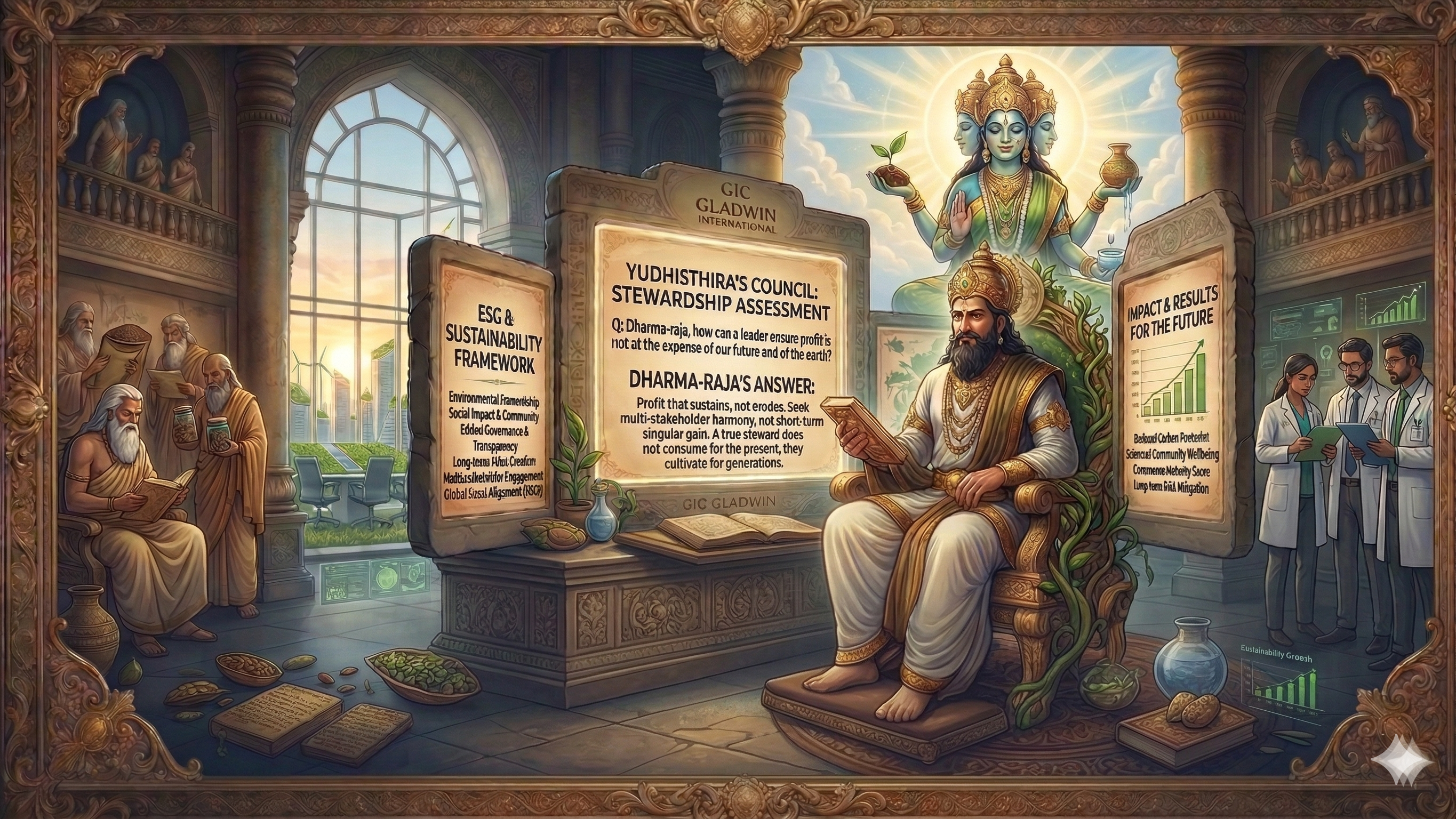
The Artwork — Bhumi Devi stands rooted in the living earth — the ESG Leadership Framework flowering around her, the sustainability metrics rising like rivers from the soil. Beside her, Shakuntala — raised by Kanva's hermitage in the forest, belonging to the natural world before she belonged to any kingdom. They did not manage the environment. They were the environment. The great ESG leader does not treat the planet as a resource to be optimised. They treat it as a responsibility that was entrusted to them before they were born.
The Bhumi Sukta — the great hymn to the Earth in the Atharva Veda — begins with an acknowledgement that has not aged by a single word in three thousand years: Mata Bhumih, Putro'ham Prithivyah. The Earth is my mother. I am her child. This is not a metaphor. It is the foundational governance principle of ancient India's relationship with the natural world — the recognition that the Earth is not a resource to be extracted but a parent to be honoured, and that the obligation of stewardship flows not from regulation but from the deepest possible sense of belonging. The great ESG leader is the one who has internalised this principle — who governs environmental and social impact not because the regulator requires it but because the obligation is real.
Bhumi Devi — Prithivi, the Earth goddess — appears throughout the Vedas and Puranas as the most patient, most generous, and most long-suffering of all the divine beings. She holds everything: every creature, every plant, every river, every city, every grave. She gives without condition and asks only one thing in return — that she be treated as she treats those who live upon her: with care, with restraint, with the understanding that what is taken must in some measure be returned. When the burden of adharma became too great — when kings and demons had exhausted her patience and her capacity to sustain the weight of injustice — she went to Brahma and asked for relief. Not in anger, but in exhaustion. She had given everything. She needed the governance of the earth to be restored.
Shakuntala's story is the complementary truth. Raised in Kanva's forest hermitage — born of Menaka and Vishwamitra but abandoned, raised by the birds and animals of the forest, belonging to the natural world before she belonged to any human institution — she carried the forest within her even after she entered the kingdom of Hastinapura. When Dushyanta forgot her — when the ring was lost and the king's memory failed and the institution chose convenience over truth — she did not beg to be remembered. She returned to her mother, Menaka, to the natural world. The forest had raised her. The forest would keep her. She did not need the kingdom's recognition to know her own worth.
These two figures together — Bhumi Devi and Shakuntala — define the two dimensions of great ESG leadership. Bhumi Devi is the systemic dimension: the understanding that the Earth has a carrying capacity, that every extraction has a consequence, that the governance of environmental impact is not a regulatory compliance exercise but a recognition of debt — the debt that every organisation owes to the natural systems that make its operations possible. Shakuntala is the relational dimension: the understanding that the communities, the ecosystems, and the living systems that sustain an organisation's social license to operate are not stakeholders to be managed but relationships to be honoured — relationships that, when neglected, do not simply wait for acknowledgement but withdraw, quietly and permanently, until the organisation finds itself alone in a kingdom it can no longer sustain.
The great ESG leader has both qualities simultaneously. They understand the metrics — the carbon accounting, the water intensity ratios, the biodiversity impact assessments, the social return on investment calculations — with the rigour of Bhumi Devi's patience: nothing escapes her notice, everything has a consequence, the accounting is always eventually settled. And they carry Shakuntala's forest knowledge: the understanding that the most important ESG risks are not in the disclosure framework but in the relationships with communities, ecosystems, and supply chain partners who have not yet chosen to withdraw their trust — but who will, when the institution continues to choose convenience over truth.
माता भूमिः पुत्रोऽहं पृथिव्याः। पर्जन्यः पिता स मामावातु॥
Maataa bhumih putro'ham prithivyaah, parjanyah pitaa sa maam aavaatu.
“The Earth is my mother; I am her child. May the rain-cloud, my father, protect me.”
— Atharva Veda XII.1.12 — The Bhumi Sukta, the great hymn to the Earth
The Four Pillars That Define the Great ESG & Sustainability
Stewardship as Obligation, Not Optimisation
Bhumi Devi's relationship with those who live upon her is not a transaction. She does not give her rivers and forests and soil in exchange for good governance — she gives them because giving is her nature, because sustaining life is her dharma. What she asks in return is not payment but restraint: the recognition that her generosity has limits, that what is taken cannot always be restored, that the governance of a kingdom's relationship with the Earth is not a resource management problem but a moral obligation. When that obligation was not honoured, she did not renegotiate. She went to Brahma.
The great ESG leader understands that the shift from sustainability-as-risk-management to sustainability-as-obligation is not semantic — it is the difference between an organisation that measures its environmental impact because the regulators require disclosure and an organisation that measures its environmental impact because it genuinely understands that its operations are drawing on natural systems that have carrying capacities, that those carrying capacities are being approached or exceeded, and that the obligation to operate within planetary boundaries is real regardless of whether it is currently enforced. This shift in understanding changes everything: the ambition of the target, the urgency of the timeline, the willingness to accept short-term cost in service of long-term stewardship.
The Forest Knowledge — Understanding What Cannot Be Measured
Shakuntala's knowledge of the forest was not the knowledge of a scientist who had studied the ecosystem from the outside. It was the knowledge of one who had been raised within it — who knew the names of every bird, the character of every tree, the seasonal rhythms of the river, the relationships between species that sustained the whole. This knowledge was not transferable through data. It was the accumulated intelligence of a lived relationship with a living system, irreplaceable in quality and impossible to reconstruct once the relationship was severed.
The great ESG leader carries the Shakuntala knowledge alongside the metrics: the understanding that the most important sustainability risks and opportunities are not always visible in the ESG disclosure framework. The community relationship that determines whether a new facility receives social license. The biodiversity corridor whose disruption will cascade through the supply chain in ways that no impact assessment will predict. The indigenous land right that is not recorded in any title deed but whose violation will end the organisation's ability to operate in that geography. This knowledge is gathered the same way Shakuntala gathered hers: by being present in the relationship, by listening to those who live within the system, by treating the ecosystem and its communities not as an external environment to be assessed but as a living relationship to be understood.
The Long Accounting — Nothing Is Lost
Bhumi Devi's patience is the most distinctive quality the Puranas assign her. She endures — seasons of drought and flood, centuries of extraction and neglect, the weight of armies and the silence of abandoned cities. She endures, and she remembers. The accounting of what has been taken from her and what has been returned is always open, never settled by time or convenience. The organisation that exhausted her patience received its relief — but the consequences of the extraction remained in the soil, the river, the air, long after the organisation that caused them had dissolved.
The great ESG leader understands the long accounting: the recognition that environmental and social impacts do not disappear from the ledger because they are no longer being measured. The carbon emitted in 2005 is still in the atmosphere in 2025. The aquifer depleted by a decade of over-extraction does not recover in a year of responsible management. The community trust destroyed by a decade of broken commitments does not return because the CEO made a speech at the sustainability conference. ESG leadership requires a temporal framework that most quarterly-reporting organisations find genuinely difficult: the willingness to account for impacts across timescales that extend beyond the current leadership team's tenure, and to make investments whose returns will be realised by their successors.
Social License as a Living Relationship
Dushyanta's forgetting of Shakuntala was not malicious. He simply chose the convenience of the court over the inconvenience of the truth. He allowed the institution — with its hierarchies, its protocols, its preference for comfort — to override the reality of a relationship that was real, that mattered, and that had obligations attached to it. Shakuntala did not fight the institution. She returned to the forest. And when the ring was found — when the evidence of the relationship was restored — Dushyanta had to travel to the hermitage to ask for forgiveness. The forest did not come to him.
Social license to operate is Shakuntala: it does not advertise its withdrawal until it has already withdrawn. The community that has lost trust in an organisation's ESG commitments does not always make its loss of trust visible through protests or regulatory complaints. It withdraws — quietly, gradually — the goodwill, the cooperation, the informal intelligence, and the civic relationship that the organisation's operations depend on. The great ESG leader monitors and nurtures social license with the same rigour they bring to environmental metrics — understanding that the relationship with communities is a living system that requires consistent investment, honest communication, and the willingness to acknowledge when the institution has chosen its own convenience over the community's truth.
How We Search for Your ESG & Sustainability
Gladwin International's ESG & Sustainability Leadership practice is built on a conviction that India is at the most consequential moment in its sustainability leadership history: the convergence of regulatory pressure (SEBI's BRSR framework, RBI's climate risk guidelines, IBBI's sustainability disclosures), investor expectation (the global shift of institutional capital toward ESG-integrated portfolios), and physical climate reality (the water stress, heat stress, and supply chain disruption that is already affecting India's most productive regions) has created a demand for ESG leadership that is simultaneously urgent and complex. The organisations that will navigate this moment well are the ones that appoint ESG leaders with the Bhumi Devi qualities — the patience to build measurement systems that are genuinely accurate, the systemic understanding to embed sustainability into the core operating model rather than the reporting function, and the Shakuntala quality — the relational intelligence to understand what cannot be measured, to listen to the communities and ecosystems that the organisation's operations affect, and to govern the social license with the same rigour as the environmental metrics. When Gladwin International searches for ESG leadership, our central question is always: does this person understand the obligation? Not just the framework. The obligation.
Bhumi Devi does not send a warning before she reaches her limit. She endures, and she endures, and she endures — and then she goes to Brahma. The organisations that are building genuine ESG leadership today are the ones that understand this: the accounting is always open, the carrying capacity is real, and the moment of reckoning is not scheduled in any regulatory calendar. It arrives when the relationship — with the natural world, with the communities, with the living systems that sustain the organisation's license to operate — has been withdrawn far enough that the cost of restoration exceeds the cost of the extraction that caused it. The great ESG leader is the one who ensures the organisation never reaches that moment: who governs the relationship with the Earth and with society with the constancy and the care of Bhumi Devi's own stewardship — giving abundantly, asking for restraint, remembering always that the Earth is not a resource we manage. She is the mother we were born to honour. That is the ESG leader Gladwin International will find for you.
Begin Your ESG & Sustainability Search
Every great ESG & Sustainability search starts with a conversation. Speak with our practice lead — confidentially, without obligation.