Vishwakarma
विश्वकर्मा
The Divine Architect Who Built Worlds No One Else Could Imagine
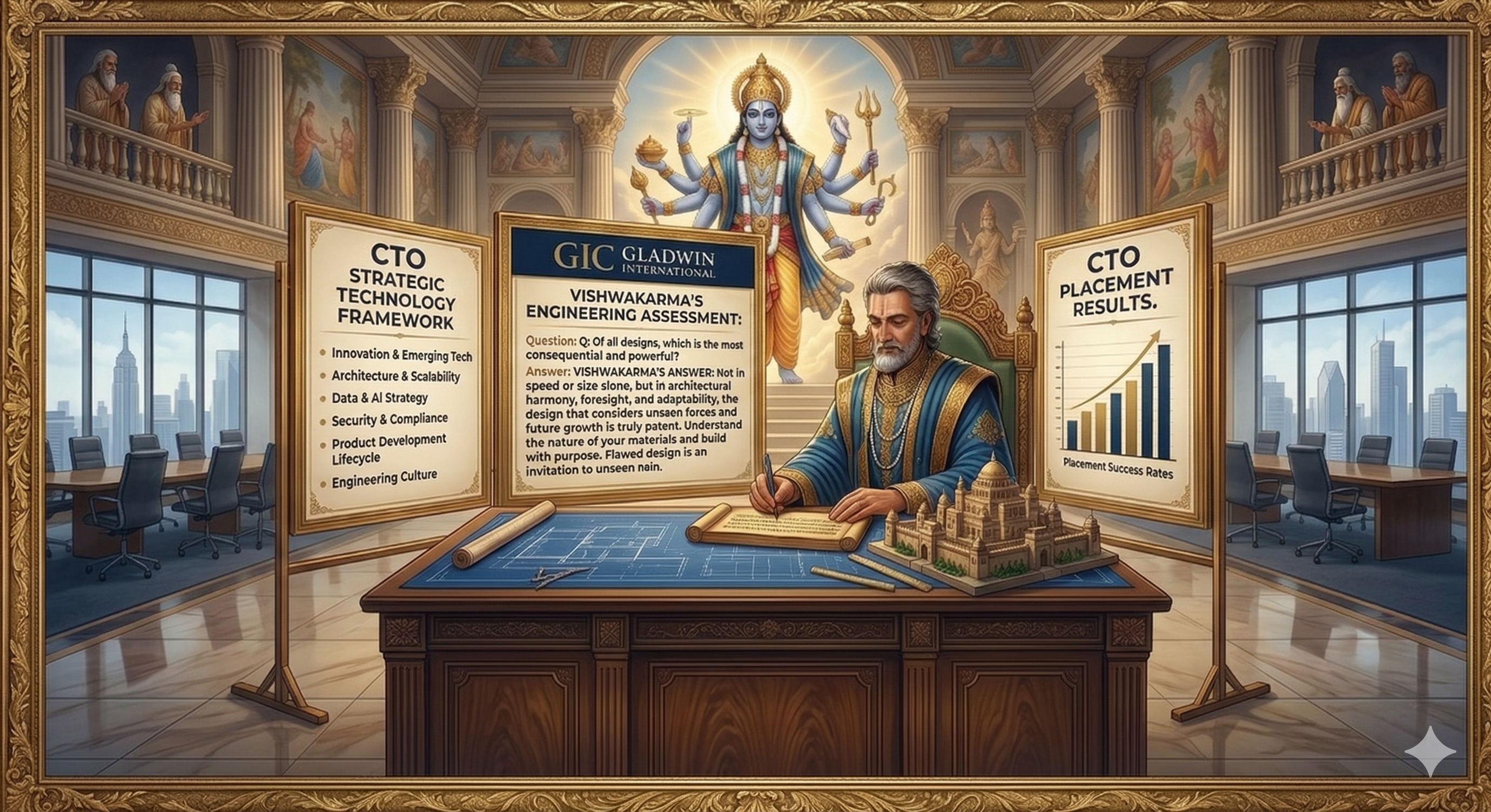
The Artwork — Vishwakarma, the all-seeing architect of the cosmos, lays out the technology blueprint that will shape a new world — his divine instruments arrayed before him, the Gladwin International CTO Practice Framework etched in the language of creation.
Every great technology leader builds what no one else believed possible — and the gods of ancient India understood this truth so profoundly that they gave their greatest builder a name that means 'maker of all things'.
Before there was Silicon Valley, before there was the industrial revolution, before the first circuit was etched on silicon — there was Vishwakarma. The Rigveda names him Vishvakarman, the All-Maker, the one whose eyes and face and arms extend to every corner of existence simultaneously, the one who forges the tools with which the universe builds itself. He is not merely the divine craftsman. He is the divine architect of reality itself.
The list of what Vishwakarma built reads like the portfolio of a legendary CTO who has shipped every impossible product. He built Lanka — the golden city of a million spires, a city so magnificent that even its conqueror Rama paused to marvel before he burned it. He built Dwarka — the submerged city of Krishna, engineered on the ocean floor to rise and fall with the tides of divine time. He forged Indra's Vajra — the thunderbolt weapon — from the bones of the sage Dadhichi, transforming sacrifice into the most destructive technology the cosmos had ever seen. He built the Pushpaka Vimana — a flying chariot that moved at the speed of thought, the world's first account of an autonomous vehicle. He made the weapons of every god. He built the halls where divine councils deliberated and the chariots in which divine warriors rode to battle.
What makes Vishwakarma more than a mythological engineer is his philosophical position. The Rigveda hymn asks him: 'What wood was it? What forest bore you? From what did you shape heaven and earth?' And Vishwakarma's answer is both technical and profound: he did not merely assemble existing materials. He saw what did not yet exist and brought it into being. He was not a builder. He was a visionary who happened to build. The distinction is the entire difference between a great CTO and a great VP of Engineering.
The CTO who carries Vishwakarma's spirit is not the one who maintains the existing system. The great CTO is the one who looks at the organisation's ambition — the market it wants to reach, the product it wants to deliver, the scale it cannot yet imagine — and builds the technological architecture that makes it possible. Not with the tools that currently exist. With the tools that will need to exist. Vishwakarma did not wait for someone to invent the divine forge. He was the divine forge. The great CTO does not wait for the technology to mature. They are the technology's maturity.
विश्वकर्मन् हविषा वावृधानः स्वयं यजस्व तन्वं सुजाताम् । त्वं हि विश्वस्य सुकृतस्य होता दिवो धर्त्री मनसो जवीयान् ॥
Vishvakarman havisha vavridhanah svayam yajasva tanvam sujatam, tvam hi vishvasya sukritasya hota divo dhartri manaso javiyam.
“O Vishwakarma, strengthened by offerings, offer yourself to your own well-born form. You are the priest of all things well-made — sustainer of heaven, swifter than thought.”
— Rigveda 10.81.7
The Four Pillars That Define the Great Chief Technology Officer / CIO
Architecture Before Assembly
Vishwakarma never built without first seeing the complete form of what he was creating. Lanka did not emerge from trial and error — it existed completely in his vision before the first stone was laid. He designed from the whole to the part, never from the part to the whole.
The great CTO builds the technology architecture before the first line of code is written. They see the system at scale before it exists at any scale. They design for the organisation five years from now, not the organisation today. The CTO who only reacts to engineering sprints is an engineering manager. The CTO who designs the future is Vishwakarma.
The Alchemy of Constraint
When the gods needed a weapon to defeat Vritra and Indra's Vajra needed to be forged, there was only one material worthy of it: the bones of the sage Dadhichi, who gave his life so that the weapon could be made. Vishwakarma took impossible constraints — sacred bones, a weapon of cosmic consequence — and created the defining tool of a generation.
The exceptional CTO never has enough time, budget, or engineers. They operate inside constraint the way Vishwakarma operated inside the divine brief: not by lamenting what is missing, but by discovering what the constraint itself makes possible. The best technology architectures in history were born from limitation. AWS was born from Amazon's internal infrastructure crisis. The iPhone was born from the decision to remove the keyboard.
Building for Gods and Mortals Both
Vishwakarma built for Indra, for Brahma, for the Devas — but he also built the tools used by farmers and weavers and blacksmiths across the mortal world. His divine craft descended into practical utility. The same mind that forged the Vajra also perfected the plough. He understood that technology without adoption is art, not engineering.
The CTO who builds only for the architecture review is building for gods. The great CTO builds for the user who is half-awake at 7am on a slow mobile connection in a second-tier city. Technology leadership means holding both truths: the elegance of the system architecture and the pragmatism of the user's actual life. The CTO who loses either loses everything.
The Craft That Outlives the Craftsman
Lanka outlasted its king. Dwarka outlasted its city. The Vajra outlasted its wielder. Every structure Vishwakarma created was designed to endure — not as monument, but as infrastructure for future generations to build upon. He built with the knowledge that he would not be there to maintain it. The craft had to be self-sustaining.
The true measure of a CTO is not what the technology does while they are there — it is what it does after they have left. The great CTO builds engineering culture, documentation, architecture principles, and team capability so profound that the system continues to grow in their absence. They are not the irreplaceable genius. They are the architect of a structure that makes the next generation of genius possible.
How We Search for Your Chief Technology Officer / CIO
Gladwin International's CTO practice is founded on a distinction that most organisations miss: there is a fundamental difference between a Chief Technology Officer and a Chief Engineering Officer, and confusing the two is one of the most expensive hiring mistakes a board can make. The CTO is Vishwakarma — the architect of the technology vision, the translator between business ambition and technical possibility, the leader who sits in the board room and tells the CEO what is achievable and in what timeframe with what investment. The Chief Engineering Officer is Bhima — pure execution force, the one who makes sure the build happens at scale and on time. We search for both. But we search for them differently. When we assess a CTO candidate, our central question is Vishwakarma's question: what have you built that did not exist before you arrived, and what does it still do now that you are gone?
Every organisation reaches a moment of technological reckoning — when the legacy system can no longer support the ambition, when the competitors have built something the internal team insists is impossible, when the board understands for the first time that technology is not a support function but the entire product. In that moment, the organisation needs Vishwakarma: the builder who sees the complete form of the future before the first component exists, who can walk into a room full of doubt and draw the architecture on a whiteboard with the calm authority of someone who has already seen it work. That is the CTO Gladwin International will find for you. The divine architect for the age you are about to enter.
Begin Your Chief Technology Officer / CIO Search
Every great Chief Technology Officer / CIO search starts with a conversation. Speak with our practice lead — confidentially, without obligation.