Krishna
कृष्ण
The Strategist Who Saw the End Before the Battle Began
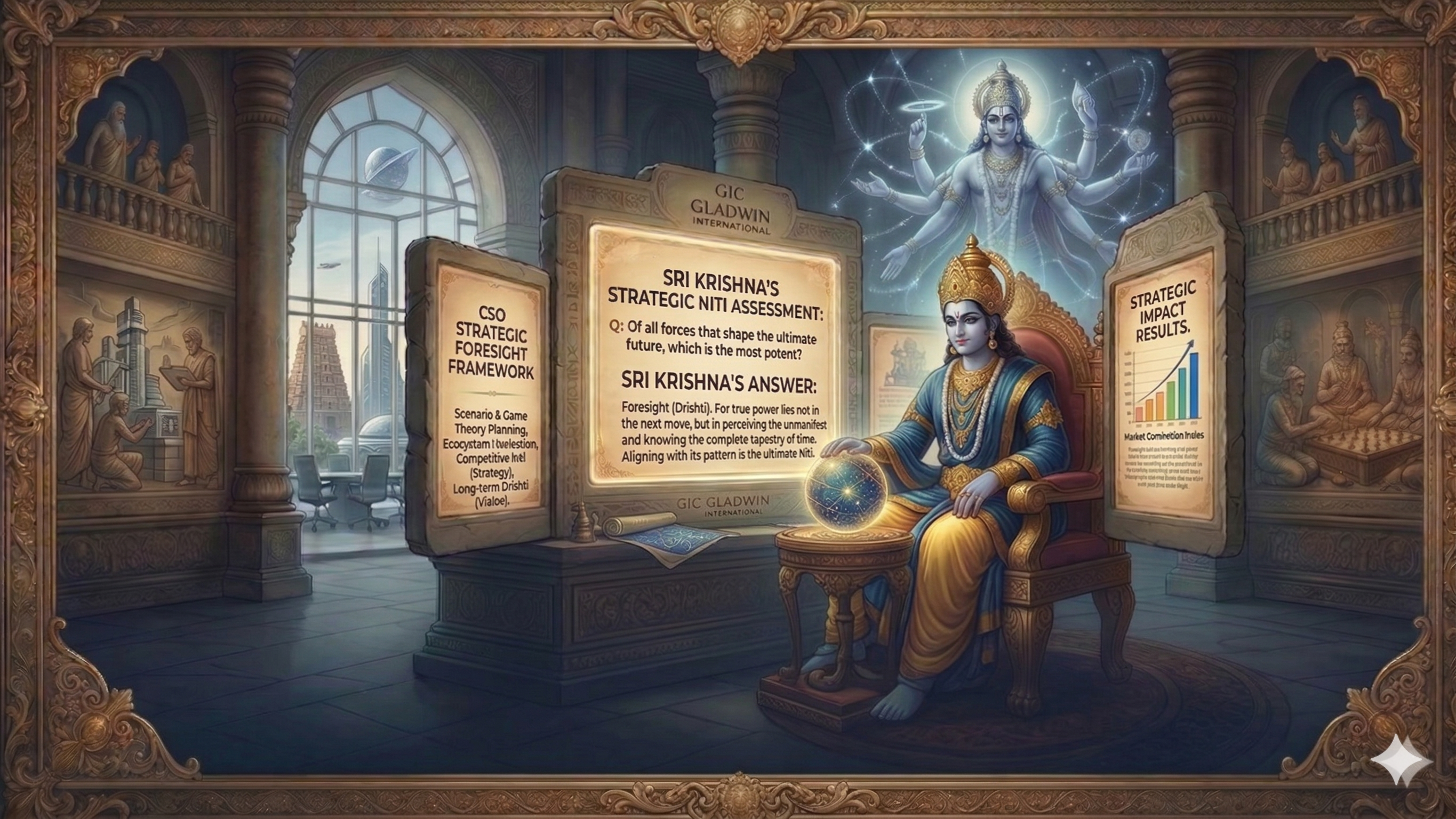
The Artwork — Krishna reveals the Virat Rupa — the universal form — to Arjuna on the battlefield of Kurukshetra. The CSO Strategic Intelligence Framework unfolds around him: every line of sight, every scenario, every consequence visible at once. Strategy is not prediction. It is the capacity to hold all futures simultaneously and choose the one that serves the highest purpose.
The Bhagavad Gita was not spoken on a mountaintop or in a palace — it was delivered on a battlefield, at the precise moment when the leader needed clarity most urgently. That is the Chief Strategy Officer: the one who finds stillness in the chaos and speaks the truth that makes action possible.
Before the first arrow was fired at Kurukshetra, Krishna had already seen the entire war. He had seen Bhishma fall on the eleventh day, Drona on the fifteenth, Karna on the seventeenth. He had seen the Pandavas victorious and the Kauravas broken. He had seen the women of Hastinapura weeping by the Ganga. He had seen all of this — and he chose, still, to stand beside Arjuna, to drive his chariot, to ensure that the war was fought on terms that would give righteousness the best possible chance to prevail. This is the essential nature of the great strategist: they already know what will happen. The question is only whether they can position the organisation to be on the right side of the outcome.
When Duryodhana and Arjuna came to Krishna before the war to ask for his support, Krishna offered a choice: his entire army, the Narayani Sena — one lakh warriors, the finest soldiers in the world — or Krishna himself, alone and unarmed. Duryodhana chose the army without hesitation. Arjuna chose Krishna. In that single decision, the strategic outcome of the war was already decided. The great strategist is not the one with the largest force. The great strategist is the one who understands that insight, clarity, and counsel are worth more than any number of soldiers.
On the morning of the battle, Arjuna looked across the field and saw his teachers, his cousins, his grandfather — and his bow fell from his hand. He said he could not fight. This was not cowardice. This was the universal crisis of leadership: the moment when the human cost of the right decision becomes visible, and the leader wavers. Krishna did not offer comfort. He offered clarity. Over eighteen chapters — the Bhagavad Gita — he dismantled Arjuna's confusion with the precision of a surgeon and the patience of an ocean. Not by telling him what to do, but by showing him who he was and what the moment required. The great CSO does not give the CEO a decision. They give the CEO the clarity to make one.
What separates Krishna from every other strategic mind in human literature is not his intelligence — it is his simultaneous hold on multiple dimensions of reality. He was a cowherd and a king, a lover and a warrior, a philosopher and a tactician, a friend and a divinity. He could speak to Arjuna as an equal and to the cosmos as its author. He never lost one perspective in order to hold another. This is the supreme gift of the great Chief Strategy Officer: the ability to hold the three-year horizon and the quarterly reality, the competitive landscape and the internal capability, the stakeholder expectation and the market truth — all at once, without simplifying any of them to make the others easier to carry.
यदा यदा हि धर्मस्य ग्लानिर्भवति भारत । अभ्युत्थानमधर्मस्य तदात्मानं सृजाम्यहम् ॥
Yada yada hi dharmasya glanir bhavati bharata, abhyutthanam adharmasya tadatmanam srijamy aham.
“Whenever righteousness declines and unrighteousness rises, I manifest myself. I arise in every age to restore what must be protected.”
— Bhagavad Gita — Chapter 4, Verse 7
The Four Pillars That Define the Great Chief Strategy Officer
The Strategy of Non-Action
Krishna's most extraordinary strategic choice at Kurukshetra was to take no direct military action. He drove the chariot. He counselled. He manoeuvred. He spoke eighteen chapters of philosophy at the moment of highest crisis. And through complete non-action as a warrior, he determined the outcome of the greatest war in mythological history. His restraint was his strategy.
The great CSO understands that the most powerful strategic moves are often those that do not appear on the roadmap. The decision not to enter a market. The acquisition not made because the price was wrong. The product line allowed to die so the organisation's energy could consolidate around what was working. The CSO who is always visibly active is often the CSO who is least strategically effective. Restraint, timing, and the discipline of non-action are as important as any strategic initiative.
Seeing All Futures Simultaneously
The Virat Rupa — the universal form that Krishna revealed to Arjuna — showed every being, every world, every future and every past simultaneously within one divine form. It was unbearable to behold. Arjuna asked him to return to his familiar human shape. But the vision had been given: the CSO is the one who has seen the Virat Rupa of the market — every scenario, every competitor, every disruption, every consequence — and can translate that overwhelming totality into a direction the organisation can actually follow.
Scenario planning, competitive intelligence, and horizon scanning are not simply analytical tools — they are the CSO's discipline for holding multiple futures simultaneously without being paralysed by any of them. The great CSO runs three futures in parallel: the world in which everything goes to plan, the world in which the primary assumption is wrong, and the world in which something entirely unpredicted changes the game. They build strategy that is robust across all three, rather than optimised for just one.
Counsel That Creates Clarity
The Bhagavad Gita's deepest strategic lesson is not about warfare or duty — it is about the nature of counsel at the moment of crisis. Krishna did not simplify. He did not offer a five-point plan. He met Arjuna's confusion with the full complexity of truth, and he trusted that a great leader, fully informed, will always find the right path. The counsel was not directive. It was illuminating.
The CSO who presents the board with a single recommended strategy, without surfacing the alternatives, the assumptions, and the risks, is not doing strategy — they are doing advocacy. The great CSO gives the leadership team the full landscape: here is what we know, here is what we do not know, here are the three paths and their respective consequences, here is my recommendation and here is exactly why I hold it. The board that emerges from that conversation is capable of making a real decision, not just ratifying a presentation.
Strategy in Service of Dharma
Every move Krishna made at Kurukshetra was in service of dharma — not the Pandavas, not personal loyalty, not political advantage. When the strategy required bending conventional rules — the deception of Drona, the timing of Karna's fall — Krishna permitted it because the higher purpose was clear. But when the purpose was compromised, the permission was withdrawn. Strategy, for Krishna, was always the servant of a higher order.
The great CSO builds strategy in service of a purpose that transcends market share — the organisation's reason for existing, its promise to its customers, its obligations to its people and communities. Strategy divorced from purpose becomes mere competitive manoeuvre, and competitive manoeuvre without purpose is eventually defeated by an organisation that knows what it is fighting for. The CSO who anchors every strategic choice to the organisation's dharma builds something that cannot easily be copied, because it is not merely a plan — it is a conviction.
How We Search for Your Chief Strategy Officer
Gladwin International's CSO practice exists because we have watched too many organisations confuse strategy with planning, and planning with execution. They are not the same thing. A plan is a document. Execution is a discipline. Strategy is a living understanding of where the world is going, where the organisation is capable of going, and how those two trajectories can be brought into alignment before the gap between them becomes unbridgeable. The CSO we search for is not the one who can build the most sophisticated strategic framework — it is the one who, when the CEO is uncertain, when the market has moved in a direction the board did not anticipate, when the three-year plan is suddenly obsolete, can walk into the room with the stillness of Krishna on the battlefield and say: here is what is actually happening, here is what it means, here is what we do. That clarity — at the moment of maximum ambiguity — is the rarest and most valuable capability in modern leadership. We search for it with the same rigour that we bring to every other dimension of our practice, and we will not close a CSO search until we are certain we have found it.
Every organisation has a Kurukshetra — a moment when the competitive landscape has shifted so dramatically that the old strategy is no longer adequate, when the leadership team is looking across the field at a changed world and the question is not 'what is our plan?' but 'who are we and what are we here to do?' In that moment, the organisation needs Krishna: the strategist who has already seen every possible future, who can hold the full complexity of the situation without being overwhelmed by it, who can translate the ungraspable totality of the market into a direction that the organisation can walk toward with conviction. That is the Chief Strategy Officer Gladwin International will find for you. The one who stands at the centre of the storm and speaks with the calm of someone who already knows how the story ends — and whose counsel makes it possible for yours to end well.
Begin Your Chief Strategy Officer Search
Every great Chief Strategy Officer search starts with a conversation. Speak with our practice lead — confidentially, without obligation.