Vidura & The Yaksha
विदुर & यक्ष
The Minister Who Named Every Peril Before It Arrived
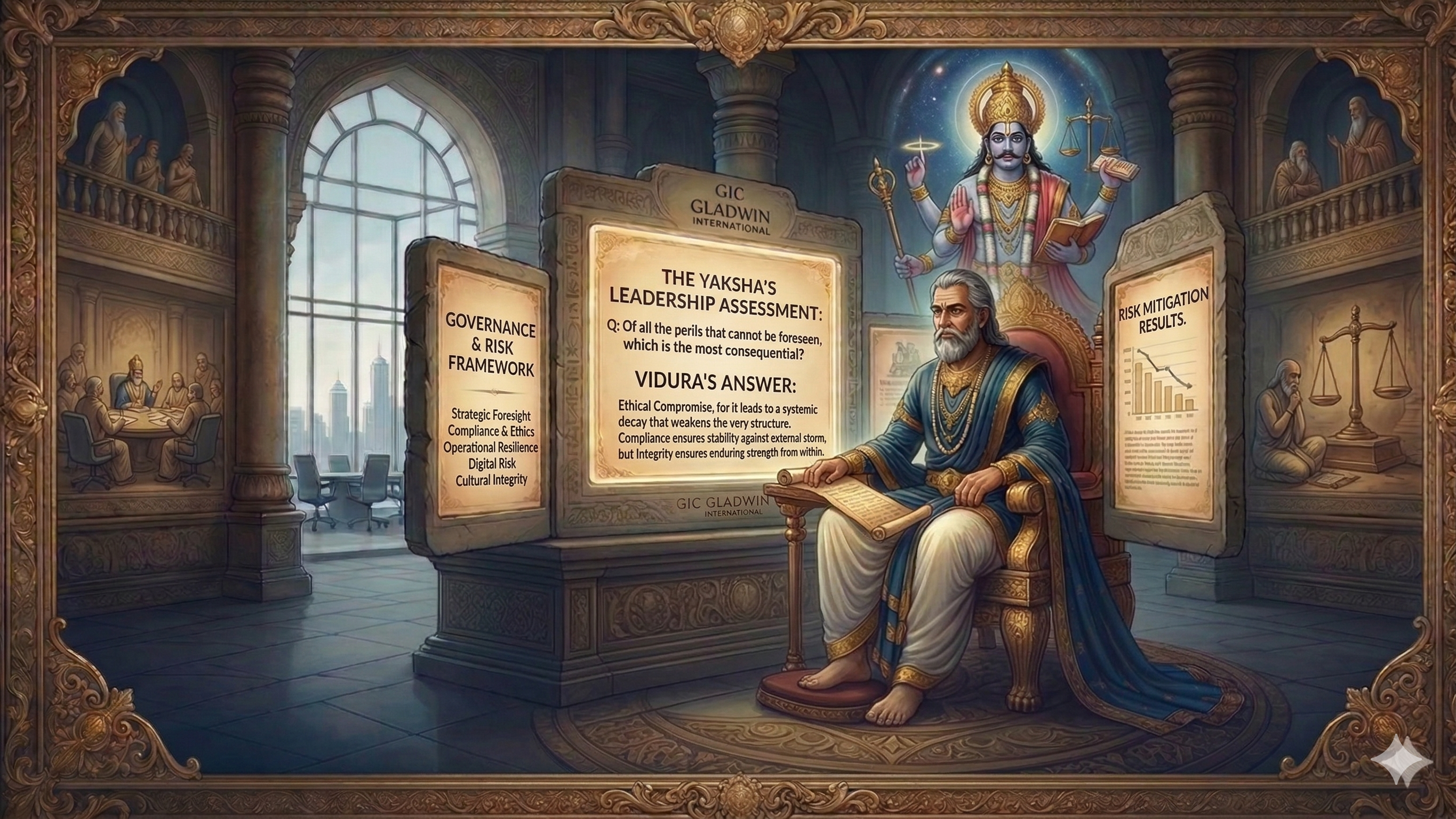
The Artwork — Vidura reads the Governance & Risk scrolls as the Yaksha — the divine spirit of cosmic consequence — presides above with the scales of judgment. The CRO Governance Framework, the Risk Mitigation Results, and the eternal question: Of all the perils that cannot be foreseen, which is the most consequential? Vidura's answer has never changed: Ethical Compromise.
Every catastrophe in the Mahabharata was preceded by a warning from Vidura that no one heeded. The great Chief Risk Officer is Vidura — the one who sees what is coming, names it precisely, and speaks it clearly into a room that would rather not hear it.
Vidura saw Kurukshetra coming decades before the first arrow was fired. He saw it in the dice game that Dhritarashtra allowed, in the humiliation of Draupadi that the court permitted, in the small injustices that compounded year after year into a culture of impunity. He named each risk as it arose. He brought it to the king. He documented it in the Vidura Niti — a systematic treatise on governance, ethics, and the consequences of compromised decision-making that remains the most practical risk management document in ancient literature. And because Dhritarashtra would not act, the war came exactly as Vidura had predicted.
The Yaksha asked the question that the Mahabharata places at the heart of all risk philosophy: 'Of all the perils that cannot be foreseen, which is the most consequential?' The question is not about market risk, or operational risk, or regulatory risk. It is about the category of risk that destroys organisations from the inside — the one that is hardest to put on a dashboard, hardest to quantify in a risk register, hardest to escalate in a board meeting. Vidura's answer was unambiguous: Ethical Compromise. Not competitive disruption. Not economic downturn. Not regulatory change. The risk that cannot be hedged, cannot be insured, and cannot be reversed once it has set in — the corruption of the organisation's moral architecture.
This is the deepest truth of enterprise risk: the risks that destroy organisations are rarely the ones on the risk register. They are the ones that were known, were manageable, were documented — and were tolerated anyway. The diesel emissions test that was failed and then falsified. The safety report that was filed and then buried. The audit finding that was raised and then settled without remedy. The Vidura Niti's central argument is that these are not isolated failures of process. They are the downstream consequence of a culture that has learned, over time, that ethical compromise carries no cost. The CRO who only manages the risk register is not managing risk. The great CRO manages the culture of risk — the organisation's collective willingness to hear, surface, and act on uncomfortable truths.
Vidura's tragedy — and his enduring wisdom — is that he was always right and almost never sufficient. He spoke truth to power in a court that preferred comfortable falsehood. He documented risk in a kingdom whose king was too afraid of his son's anger to act. He remained in that court, speaking, warning, documenting, long after it was safe to do so, because he understood that the role of the risk conscience is not to prevent every catastrophe — it is to ensure that the catastrophe, when it comes, cannot be said to have arrived unannounced. The great CRO is not measured by whether they prevented every loss. They are measured by whether the organisation, in its moment of crisis, can say: we knew, we were warned, and we had a plan.
अनागतविधाता च प्रत्युत्पन्नमतिस्तथा । द्वावेतौ सुखमेधेते यद्भविष्यो विनश्यति ॥
Anaagata-vidhaata cha pratyutpanna-matis tatha, dvavitau sukham edhete yadbhavishyo vinashyati.
“The one who prepares for what has not yet come, and the one who responds with clarity in the present moment — both of these prosper. The one who says 'let us see what happens' is destroyed.”
— Vidura Niti — Mahabharata, Udyoga Parva (33.69)
The Four Pillars That Define the Great Chief Risk Officer
Naming the Unnameable Risk
Vidura's most distinctive quality was his willingness to name the risk that no one else in the court would name. When every minister saw Duryodhana's behaviour as a family matter, Vidura named it as a constitutional crisis. When the dice game was framed as entertainment, Vidura named it as institutional corruption. He did not soften the language to make it easier to hear. He made it harder to ignore.
The great CRO is the one who names the category of risk that the organisation is most reluctant to acknowledge — the cultural risk embedded in how the CEO makes decisions, the governance risk in how the board is constituted, the ethical risk in a commercial practice that is legal but corrosive. Risk registers are valuable. They are also, by their nature, documents of the risks an organisation is willing to acknowledge. The great CRO is responsible for the risks beyond the register — the ones that require political courage to surface and institutional courage to address.
Ethical Compromise as Systemic Risk
The Yaksha's answer — that ethical compromise is the most consequential unseen peril — was not a philosophical statement. It was a systems diagnosis. Vidura had watched the Kuru kingdom compromise its ethics in small increments over decades, and he had traced the causal chain: each small tolerance of adharma weakened the institutional immune system, making the next tolerance easier, until the institution was no longer capable of rejecting even the largest injustice. The war was not a sudden catastrophe. It was the terminal expression of a long moral decline.
Every major corporate catastrophe of the modern era has an ethical compromise at its origin — not a dramatic, obvious act of corruption, but a small decision, early in the sequence, to look away. The CRO who treats ethics as a compliance function rather than a risk function has misunderstood the most dangerous category of organisational exposure. The great CRO tracks the organisation's ethical vital signs with the same rigour they apply to its financial controls — because the first is as predictive of long-term organisational health as the second.
The Governance of Foresight
Vidura's Niti was not a reactive document. It was written prospectively — a systematic articulation of the conditions under which kingdoms fail, long before any specific kingdom was in crisis. He was practising what we would today call horizon risk management: the identification and mitigation of risk categories before they manifest as specific events. His governance framework was designed to make the organisation's immune system stronger, not merely to treat the symptoms of the current illness.
The great CRO builds risk architecture for threats that do not yet exist on the risk register — AI-driven fraud vectors, climate liability, geopolitical supply chain fragility, the reputational risks of digital transparency. They are not reactive managers of documented risk. They are prospective architects of resilience, building the organisation's capacity to absorb shocks that have not yet been named, from directions that have not yet been identified. Compliance ensures stability against the external storm. Integrity ensures enduring strength from within.
Speaking Truth When Truth Is Unwelcome
Vidura remained in Dhritarashtra's court long after it was comfortable to do so, continuing to speak, continuing to document, continuing to warn — not because he expected to be heeded, but because he understood that the record of the warning was itself a form of governance. When the war came, every participant knew that it had been foreseen, named, and preventable. That knowledge changed the moral accounting of the catastrophe. Vidura's persistence was itself an act of institutional integrity.
The CRO who softens the risk assessment to avoid conflict with the CEO has abandoned their function. The great CRO escalates the finding that makes the board uncomfortable, names the control failure that implicates a senior leader, and maintains the accuracy of the risk register even when accuracy is politically costly. Their independence is not bureaucratic obstinacy — it is the entire point of having a CRO. An organisation that only hears the risks it wants to hear is not managing risk. It is managing appearances. And appearances, as Vidura knew, are the most dangerous form of comfort.
How We Search for Your Chief Risk Officer
Gladwin International's Chief Risk Officer practice is built on a single conviction: the most valuable CRO is not the one with the most sophisticated risk framework — it is the one who has the organisational courage to use it. We have conducted enough CRO searches across India's regulated industries to know the difference between a risk professional who has built an excellent control architecture and a risk leader who will walk into the CEO's office, close the door, and say 'what we are doing with this acquisition creates an exposure that the board has not been shown.' The first is valuable. The second is irreplaceable. When we assess CRO candidates, our central question is always the Yaksha's question: what is the most consequential peril you have ever named that your organisation did not want to hear? And what happened when you named it? The answers to those two questions tell us everything we need to know about whether this person is Vidura — or whether they are another voice that will fall silent at the critical moment.
Every organisation has a Kurukshetra in its future — a moment of consequence that will be directly traceable to decisions made years earlier, risks tolerated when they were small, warnings that arrived but were not acted upon. The organisations that survive that moment are the ones that had a Vidura: a Chief Risk Officer who named the risks before they compounded, who documented the warnings before they became unavoidable, who maintained the integrity of the governance architecture even when the pressure to compromise was greatest. That is the CRO Gladwin International will find for you. Not the one who manages the register. The one who manages the truth — because in the long arc of organisational life, truth is the only risk management that has never failed.
Begin Your Chief Risk Officer Search
Every great Chief Risk Officer search starts with a conversation. Speak with our practice lead — confidentially, without obligation.