Maya Danava
मय दानव
The Cosmic Architect Who Built What the Gods Could Not Imagine
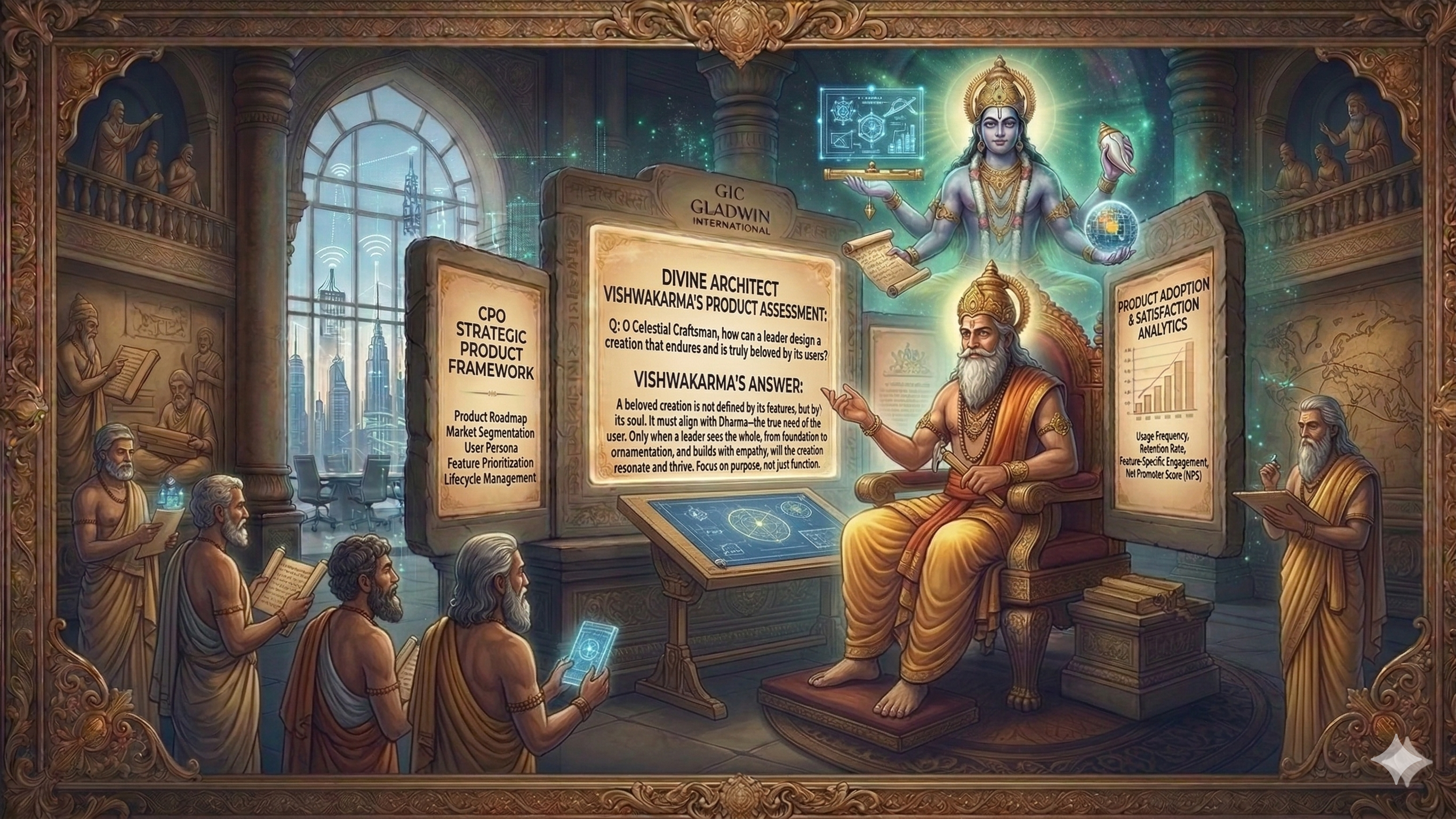
The Artwork — Maya Danava stands at the blueprints of the impossible — the CPO Product Architecture Framework arrayed before him, the Indraprastha Crystal Palace taking form beyond. He is the builder who makes people question what is real. The great CPO builds products that users enter and forget the world outside.
When the Pandavas needed a palace at Indraprastha, they did not commission a builder. They commissioned Maya Danava — the greatest architect in all creation, the builder of the celestial city of Dwaraka, the constructor of impossible geometry. Maya built them a palace where the floor was water that looked like stone, and the stone looked like water. Where walls appeared to be windows and windows appeared to be walls. Where visitors walked into solid crystal thinking it was open air. He did not build a palace. He built an experience that re-ordered reality. The great Chief Product Officer builds the same way.
Maya Danava was the architect of the asuras — the divine craftsman of the anti-gods — and his reputation was so formidable that even the gods acknowledged his supremacy in the art of creation. When Arjuna saved Maya from the fire at Khandava, Maya asked how he could repay the debt. Arjuna, characteristically, asked for nothing. Maya turned to Yudhishthira and built him the Sabha — the palace at Indraprastha — that would become the most famous building in the Mahabharata and the proximate cause of the war itself.
The palace Maya built was a masterwork of designed confusion and deliberate wonder. Every surface was crafted to deceive the eye in service of a larger experience — to make the visitor feel that they had entered a different dimension of reality, one where the ordinary rules of material perception no longer applied. The crystal floors that looked like pools of water caused the great Duryodhana to pull up his robes as he walked, afraid to get wet. The actual pool of water that looked like a crystal floor caused him to step forward confidently and fall in. The palace did not merely house its inhabitants. It produced an experience so total and so coherent that it overrode the visitor's existing model of what was possible.
This is the essential philosophy of great product leadership. The product that merely functions — that solves the stated problem, delivers the specified features, meets the agreed acceptance criteria — is not what the great CPO builds. The great CPO builds the product that makes users forget they are using a product. The one that feels inevitable in retrospect — as though the world could not have been organised any other way — but was impossible to imagine before it existed. Maya's genius was not in the quality of his materials or the efficiency of his process. It was in his ability to hold the total user experience as a single coherent intention and craft every detail — every surface, every transition, every moment of first contact — in service of that intention.
The crisis that Maya's palace ultimately precipitated — Duryodhana's humiliation, his burning jealousy, his determination to destroy what the Pandavas possessed — reveals the second truth of great product creation: the product that is merely good is ignored. The product that is genuinely extraordinary provokes a response. Great products do not just satisfy customers. They reorganise markets. They make competitors question their own offering. They create the kind of envy that is indistinguishable from the desire to possess. Maya built a palace that Duryodhana could not look at without wanting to take. Every great CPO should aspire to build the equivalent: the product whose existence makes every competitor in the market uncomfortable.
न तत्र सूर्यो भाति न चन्द्रतारकं नेमा विद्युतो भान्ति कुतोऽयमग्निः । तमेव भान्तमनुभाति सर्वं तस्य भासा सर्वमिदं विभाति ॥
Na tatra suryo bhaati na chandra-taarakam, nema vidyuto bhaanti kuto'yam agnih; tameva bhaantam anubhaati sarvam, tasya bhaasaa sarvam idam vibhaati.
“The sun does not shine there, nor the moon, nor the stars — lightning does not illuminate it, much less ordinary fire. Everything shines by reflecting that light alone; by its radiance, all this is illuminated.”
— Katha Upanishad 2.2.15 — the verse Maya's palace embodied in stone and crystal
The Four Pillars That Define the Great Chief Product Officer
The Experience Over the Feature
Maya did not build the Indraprastha palace by listing features and prioritising them by user vote. He built from a single coherent intention: to create an experience of reality so total and so precisely crafted that every visitor's model of what was possible would be permanently altered. Every individual element — the crystal floor, the reflecting pool, the false wall — was in service of this total experience. No feature existed for itself. Every feature existed for the visitor's encounter with the whole.
The great CPO does not manage a feature backlog. They manage a product intention. The feature backlog is a symptom of the absence of a coherent product vision — the organisation's way of responding to customer demand without understanding what experience they are trying to create. The great CPO asks not 'what do users say they want?' but 'what experience are we trying to produce — and what features, in what sequence, in what design, serve that experience?' This is the difference between the product that grows by satisfying individual requests and the product that grows by creating an experience that users cannot imagine living without.
Designed Confusion as Competitive Moat
The genius of Maya's palace was not that it was beautiful — many palaces were beautiful. It was that it was designed to be disorienting in precisely calculated ways. The confusion it produced was not accidental; it was the intended experience. The visitor who walked carefully across the crystal floor — afraid to get wet — was experiencing exactly what Maya had designed. The product did not just solve a problem. It created a new kind of encounter with reality that only this product could produce.
The great CPO understands that the most durable competitive moats are experiential, not functional. A competitor can copy a feature. They cannot copy the accumulated result of ten thousand small design decisions that together produce an experience of ease, inevitability, and delight that feels effortless but is the product of extraordinary intentionality. The CPO who focuses on functional parity with competitors is playing a game they cannot win. The CPO who focuses on building an experience that is coherently and distinctively theirs is building a moat that takes years to replicate — because it is not the features that make it; it is the philosophy behind the features.
Building the Impossible on Schedule
Maya built the Indraprastha palace — the most complex, most technically extraordinary structure in the Mahabharata — as a gift of gratitude, delivered. He did not propose a design, seek approval, iterate through requirements, and deliver a prototype. He built. The capacity to hold an extraordinary creative intention and translate it into a delivered reality — without losing the vision in the process — is the rarest and most valuable quality in any creator.
The great CPO's fundamental challenge is the translation gap: the distance between the product they can envision and the product their organisation can build. Narrowing this gap requires three simultaneous capabilities — the creative vision to hold the intended experience clearly enough to make design decisions; the engineering partnership to understand what is actually buildable and in what sequence; and the organisational leadership to maintain the coherence of the vision across a team of specialists who each see only their piece of the palace. The CPO who cannot do all three does not build the Maya palace. They build a committee product.
The Product That Provokes
Duryodhana's reaction to the Indraprastha palace — his humiliation, his burning desire to possess it, his determination to destroy what he could not have — is the greatest product success metric in the Mahabharata. Maya did not build a palace that was adequate or impressive or competitive. He built a palace that reorganised the emotional universe of everyone who entered it. The most important consequence of the Indraprastha palace was not that the Pandavas lived in it. It was that Duryodhana could not stop thinking about it.
The great CPO measures success not just in retention and NPS but in the competitor's response. When the competitor's board is asking why their product does not feel like yours — when the trade press is writing about what you have built rather than what the market demanded — when customers are recommending you not because you solved a problem but because of how it felt to have the problem solved — that is the Maya test. The product that merely satisfies is forgettable. The product that reorganises the market's sense of what is possible is the product that wins. Build the palace that makes Duryodhana pull up his robes.
How We Search for Your Chief Product Officer
Gladwin International's Chief Product Officer practice is built on a conviction that the CPO search market has systematically confused two fundamentally different jobs. The first is the product manager who has been promoted — the person who is excellent at managing backlogs, running sprint reviews, coordinating between engineering and design, and delivering features on roadmap. This person is essential and should be recognised and rewarded accordingly. The second is the product leader — the person who can hold a product vision coherent across years, who understands what experience they are building before they know what features will produce it, who can walk into a room of engineers and designers and communicate the palace Maya intended — not the list of materials Maya ordered. The organisations that are building category-defining products need the second. Most CPO searches look for the first. When Gladwin International searches for a CPO, we are always looking for the Maya — the one who has already built something that made the market uncomfortable.
Maya Danava was not the most powerful figure in the Mahabharata. He did not fight at Kurukshetra. He did not advise kings or mediate dharma. He built a palace — and that palace changed the entire course of the epic. The product that the great CPO builds can do the same: it can reorganise the market, reorder the competitive landscape, and create consequences whose full extent is only visible years after the product first shipped. That is what great product leadership produces. Not a roadmap. Not a feature set. A palace that makes the world look different from the inside. That is the Chief Product Officer Gladwin International will find for you.
Begin Your Chief Product Officer Search
Every great Chief Product Officer search starts with a conversation. Speak with our practice lead — confidentially, without obligation.