Vidura
विदुर
The Minister Whose Execution Never Once Failed the Kingdom
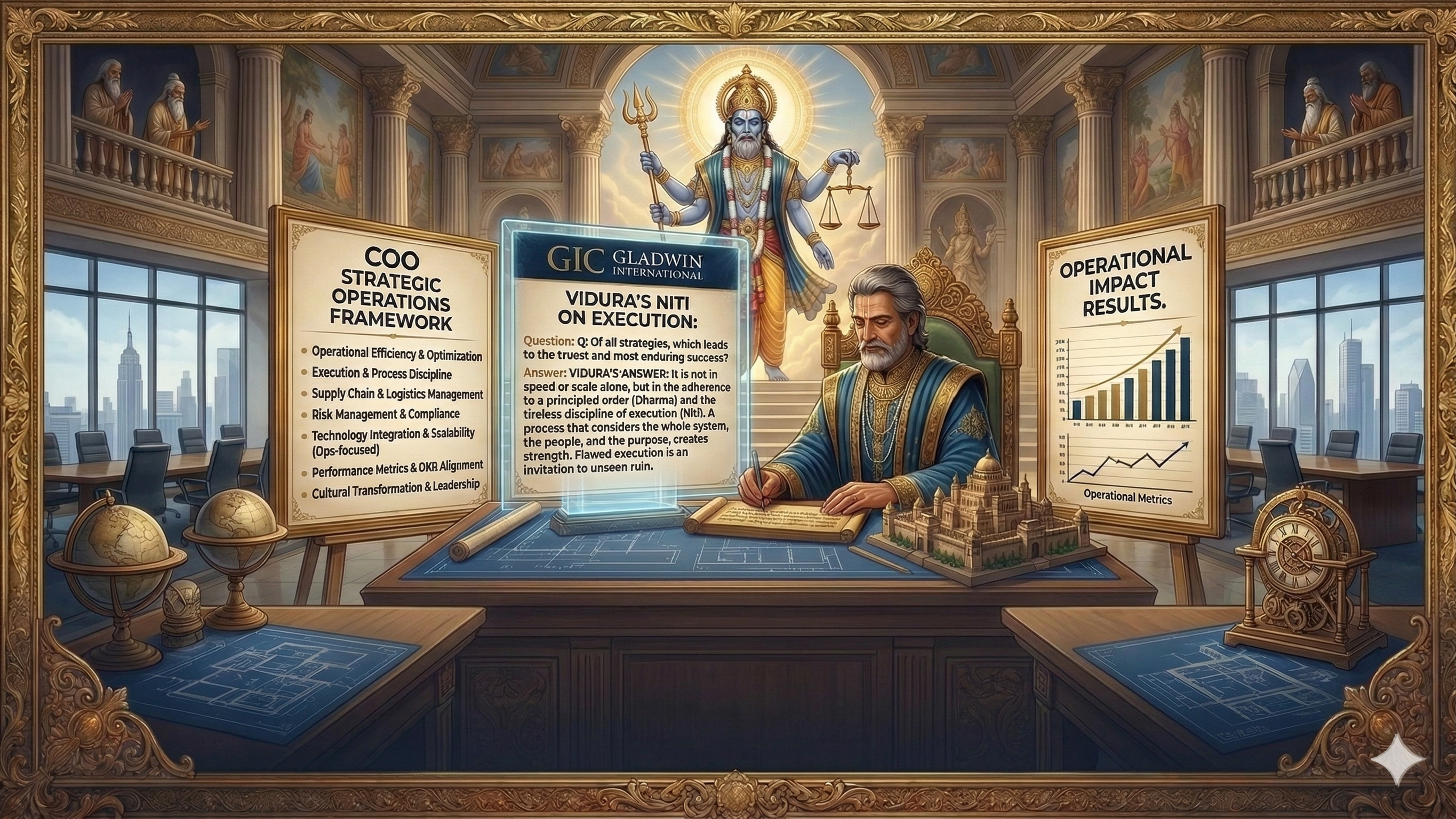
The Artwork — Vidura studies the Execution Scrolls at his operations desk — the COO Strategic Operations Framework arrayed before him, the divine scales of Dharma balanced above. He asks the question that separates the great COO from the adequate one: Of all strategies, which leads to the truest and most enduring success? His answer has never changed: not speed or scale alone, but principled order and the tireless discipline of execution.
Vidura served as Prime Minister to three successive generations of the Kuru dynasty. He did not win battles. He ran the kingdom. He ensured that the decisions made in the court became the realities experienced by every citizen, every army, every grain store, and every judicial proceeding from Hastinapur to the frontier. The great Chief Operating Officer is Vidura's Niti made institutional — the systematic translation of strategy into disciplined, principled, enduring execution.
Vidura's operational genius lay not in any single act of brilliance but in something far rarer: perfect consistency over decades. As the kingdom around him descended into dysfunction — the dice game, the exile, the gathering of armies — Vidura continued to perform his operational duties with unfailing integrity. He ensured the granaries were maintained, the borders were administered, the justice was delivered, and the machinery of governance continued to function even as the political edifice above it was cracking. He was the one who kept the state operational while the state was destroying itself.
The Vidura Niti — his collected operational and governance wisdom — is the Mahabharata's most practical text. It is not about heroism or divine intervention. It is about how an organisation must actually function to survive: the qualities of the advisor who can be trusted, the decision-making process that produces durable outcomes, the dangers of moving too fast versus too slow, the difference between the action that looks effective and the action that is effective. It is, in every sense, the ancient world's most sophisticated operations manual.
Vidura's most defining operational quality was his understanding of what he would later articulate in his Niti: that it is not speed or scale that determines enduring success, but principled order — Dharma — and the tireless discipline of consistent execution — Niti. He saw organisations around him that moved fast and collapsed. He saw empires that scaled beyond their operational capacity and disintegrated. The Kuru kingdom endured not because of Dhritarashtra's vision or Duryodhana's ambition — it endured, for as long as it did, because of Vidura's operations.
When Vidura finally left Hastinapur — when the kingdom's ethical collapse had gone beyond what his operational integrity could correct — he did not leave the machinery of governance in disorder. He completed every task that was in motion. He left every commitment fulfilled. He handed over every responsibility that could be handed over. Even in leaving, Vidura was operationally impeccable. The great COO, when they eventually move on, leaves behind an organisation that runs better than they found it — not dependent on their presence, but structured by their discipline.
न चाभिमानः स्थानेषु न च मानस्य विस्मृतिः । न चालस्यं न चाकाले व्यवहारः प्रशस्यते ॥
Na chabhimanah sthaneshu na cha manasya vismritih, na chalasyam na chakale vyavaharah prashasyate.
“Not arrogance in one's position, not forgetting one's purpose, not laziness, not acting out of season — this is the conduct that is truly praiseworthy in one who governs.”
— Vidura Niti — Mahabharata, Udyoga Parva (33.41)
The Four Pillars That Define the Great Chief Operating Officer
Principled Order Over Expedient Speed
Vidura's operational philosophy was built on a distinction that most of his contemporaries refused to make: the difference between the action that produces an immediate result and the action that produces an enduring result. Every time the Kaurava court chose expedience — the dice game, the exile, the diplomatic dishonesty — Vidura named the operational consequence. He was not anti-action. He was pro-durability. He understood that an operation built on principle compounds; an operation built on expedience corrodes.
The great COO is the person who slows the organisation down at exactly the right moment — not because they lack urgency, but because they understand that a process that skips its quality gates will revisit every skipped step at far greater cost downstream. They are the one who insists that the product is not shipped before it is ready, that the vendor is not selected before it is vetted, that the team is not hired before the role is defined. This is not bureaucracy. This is Vidura's Niti: the understanding that principled order, consistently applied, is the only operational architecture that compounds over time.
Consistency as Competitive Advantage
Vidura's most remarkable operational quality was not any single decision — it was the absence of variance. Over decades of service to three kings, his execution quality did not fluctuate with the political weather. When the court was stable, he executed with discipline. When the court was in crisis, he executed with the same discipline. The Kuru kingdom's operational continuity in the face of constant political dysfunction was Vidura's single most valuable contribution.
The great COO delivers in Q2 what they promised in Q1. Not approximately. Not directionally. They deliver. The organisation knows what to expect from the operations function because the operations function has never given it a reason to be surprised. This consistency — this operational absence of drama — is the most underrated capability in a COO. Every board that has experienced an operations crisis knows exactly what it is worth. Every organisation that has never experienced one assumes it is the default state of affairs. It is not. It is the product of a Vidura — a leader who considers operational reliability a personal commitment, not an outcome.
The Niti of Resource and Rhythm
Vidura's Niti is precise on the operational misuses that destroy kingdoms: waste before shortage, action before assessment, scale before structure, delegation without accountability. He enumerated these not as moral failures but as operational failures — things that weaken the system's ability to respond when it is most needed. His operational wisdom was fundamentally a theory of institutional resilience: how to build the organisation so it does not break under stress.
The great COO runs the organisation at its sustainable rhythm — not its maximum sprint. They know the difference between utilisation that builds capability and utilisation that burns it out. They size the supply chain for the demand curve, not the peak dream. They build processes that work when two key people are on leave, not just when everyone is present and fully rested. This operational conservatism is not timidity — it is the COO's version of Vidura's Niti: the explicit design of the organisation's operating model around the conditions under which it will actually need to perform.
The Operational Conscience of the CEO
Vidura spent his career as the voice that named what the king would not hear: the operational consequences of political decisions, the practical realities behind the strategic ambitions, the cost in human and material terms of choices that were made in the court without consulting the realities of the field. He was not disloyal. He was the most loyal advisor the kingdom had, because he was the only one willing to tell the king what implementation actually required.
The great COO is the one who says, in the room where the strategy is being celebrated, 'This requires eighteen months of supply chain restructuring before we can deliver it at the margin we have promised.' They do not say it to diminish the strategy. They say it because the strategy without operational honesty is not a strategy — it is an aspiration. The CEO who has a COO they can rely on for operational truth has the rarest thing in corporate life: a partnership where the plan and the reality move in the same direction, because someone is accountable for making them align.
How We Search for Your Chief Operating Officer
Gladwin International's COO practice begins with a question that most COO searches never ask: what does this CEO's blind spot cost the organisation operationally, and who can cover it without making the CEO feel uncovered? The COO role is not a general management role. It is a precision complement to a specific leader at a specific moment. A visionary CEO who executes in headlines needs a COO who executes in detail — the Vidura to the Dhritarashtra, who makes sure that the things the king cannot see still get done, correctly, on time, with integrity. An operationally focused CEO may need a COO who extends the organisation's strategic reach rather than replicating the CEO's operational strength. We build the profile from the CEO outward, not from a generic job description inward. And when we assess COO candidates, we spend most of our time on consistency — not on their best quarter, but on their worst, and on what the organisation looked like when they left.
The great organisations of any era are not remembered for their most brilliant strategies. They are remembered for the reliability of their execution — the decade-by-decade accumulation of things done right, on time, without drama, by people who treated operational discipline as a personal commitment rather than a job requirement. Vidura built that culture in Hastinapur for three generations. The kingdom collapsed when it stopped listening to him — not when it ran out of warriors. The Chief Operating Officer Gladwin International will find for you is the one who builds the operational culture that outlasts their tenure, who makes the organisation more capable by the time they leave than when they arrived, and who treats every operational commitment as a debt of honour that must be repaid in full.
Begin Your Chief Operating Officer Search
Every great Chief Operating Officer search starts with a conversation. Speak with our practice lead — confidentially, without obligation.