Vidura
विदुर
The Minister Who Would Not Compromise
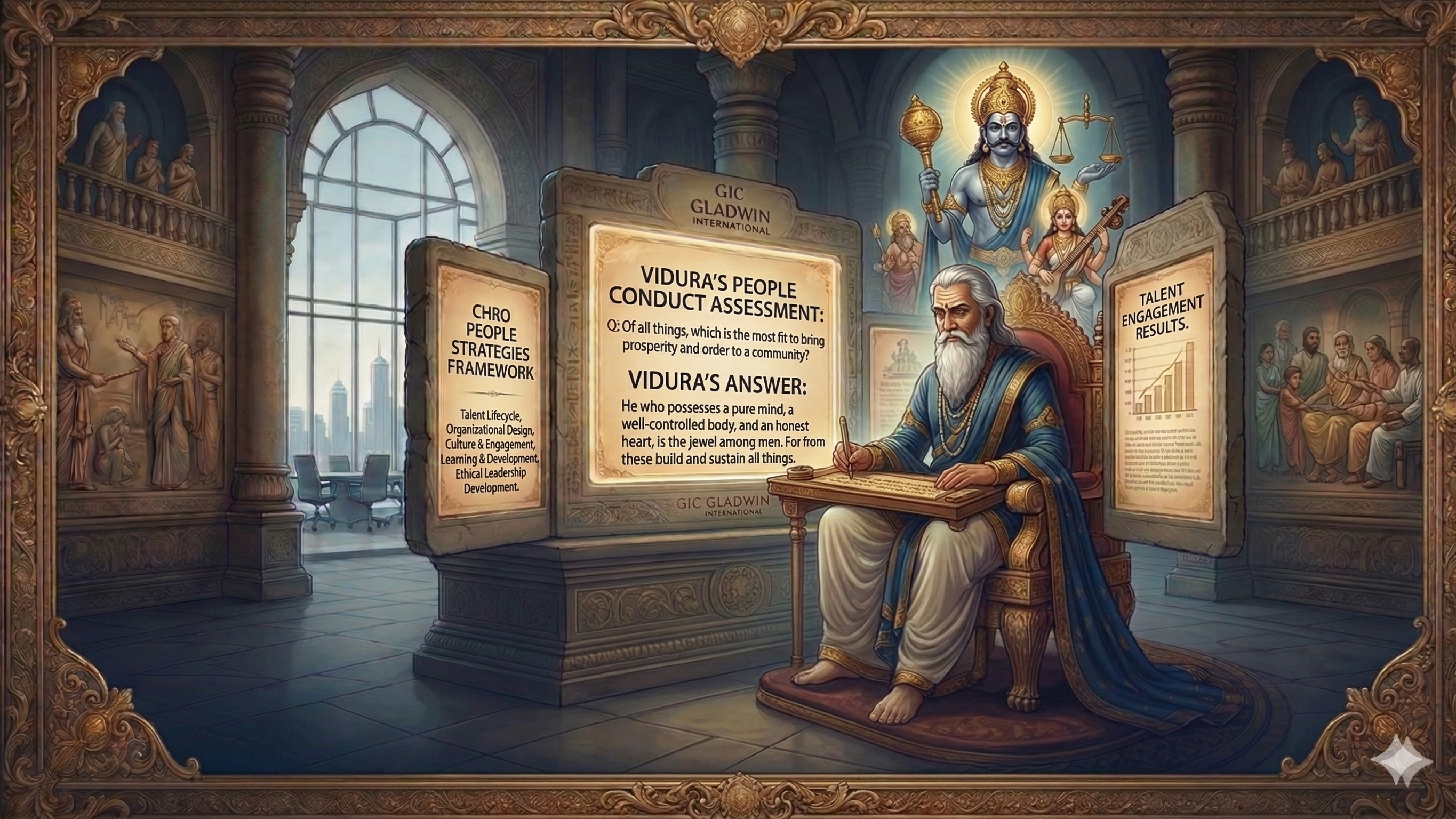
The Artwork — Vidura presents his People Conduct Assessment in the great assembly — the CHRO People Strategies Framework spread before him, as Dharma and Saraswati bear witness above. The jewel among men is he who possesses a pure mind, a controlled body, and an honest heart.
Every organisation's culture is the shadow of its CHRO — and Vidura taught us 2,500 years ago that the only leader worthy of shaping human culture is the one who cannot be bought, cannot be threatened, and will not lie to the king.
In the court of Hastinapura, there was a minister unlike any other. Vidura — half-brother to the blind king Dhritarashtra and the noble Pandu — held no army, no kingdom, and no claim to the throne. What he held was something rarer: the complete and unshakeable conviction that truth and ethics were non-negotiable, regardless of what the king commanded. In a court populated by warriors, princes, and strategists, Vidura was the only one who consistently spoke the uncomfortable truth.
When the Kauravas were scheming against the Pandavas, it was Vidura who warned Yudhishthira. When Dhritarashtra was blinded by love for his sons, it was Vidura who said, plainly, that the king's partiality would destroy the dynasty. When Draupadi was being humiliated in the open court and every warrior, every elder, every knight looked away — it was Vidura who stood and said that what was happening was adharma, and that silence made every man in that room complicit.
The Vidura Niti — his collected teachings on conduct, ethics, and the qualities of great people — remains one of the most practical and radical documents in Indian philosophy. His central insight: 'He who possesses a pure mind, a well-controlled body, and an honest heart, is the jewel among men. For from these build and sustain all things.' Not skill. Not intelligence. Not strategy. Character. The CHRO who builds an organisation must start there — with the irreducible core of human character.
Vidura was never the king. He was always the counsel — the one who held the ethical compass when the king's hands were on other instruments. He refused to fight in the Kurukshetra war because he could not fight for adharma, even for the side that had fed him. He chose exile over complicity. This is the archetype of the great CHRO: the leader who will not build a culture they cannot stand behind, who will not hire leaders they cannot vouch for, and who will resign before they enable systematic injustice inside an organisation.
शुचिः प्राज्ञो नरो लोके जितात्मा विजितेन्द्रियः । लब्ध्वा मनुष्यजन्म श्रेष्ठं वर्तते यः स पण्डितः ॥
Shuchih pragno naro loke jitatma vijitendriyah, labdhva manushyajanma shreshtham vartate yah sa panditah.
“He who possesses a pure mind, a well-controlled body, and an honest heart, is the jewel among men. From these qualities alone are all great things built and sustained.”
— Vidura Niti — Mahabharata, Udyoga Parva (33.11)
The Four Pillars That Define the Great Chief Human Resources Officer
Character Before Competence
Vidura's entire philosophy rested on one premise: skill without character is dangerous. He watched warriors of supreme ability — Karna, Drona, Bhishma — choose the wrong side because their character had been compromised by loyalty, debt, or vanity. Skill amplifies what is already inside a person.
The CHRO who only assesses competency frameworks is building on sand. The great CHRO evaluates character first — the candidate's track record of decisions under pressure, their history of speaking uncomfortable truths, their response when the institution asked them to compromise. Competence can be developed. Character arrives fully formed.
The Courage to Say No to the King
In the entire Kuru court, only Vidura publicly objected to the disrobing of Draupadi. Every other minister, warrior, and elder looked away. Vidura spoke — and was silenced by Duryodhana. He spoke again. He was exiled. He still spoke. The record of history remembers only Vidura as the conscience of that court.
The CHRO who cannot say no to the CEO has no real function. The great CHRO must be willing to halt a hire that the board wants, flag a cultural crisis the leadership team is ignoring, and surface the HR reality that the strategy deck has obscured. If the CHRO only ever says yes, the organisation has an expensive admin function — not a people leader.
Culture Is the Accumulation of What You Tolerate
The rot in the Kuru kingdom did not begin with the dice game. It began years earlier, when small injustices were tolerated, when Duryodhana's cruelty was excused as youthful exuberance, when the court looked away from the first acts of adharma. Vidura saw it all and documented it all. The culture of Hastinapura was built one tolerated injustice at a time.
Every organisation's culture is built one tolerated behaviour at a time. The CHRO's most important function is not the HR handbook — it is the daily decision of what gets excused, what gets addressed, and what gets escalated. The leader who looks away from the first instance of misconduct has already decided what the organisation's culture will become.
People as the Organisation's Only Real Asset
Vidura's most radical teaching was also his simplest: the quality of an organisation is entirely determined by the quality of the people within it. Not its resources, not its strategy, not its geography. The people. He spent his career in service of this conviction — advising, warning, counselling — because he understood that the Kuru dynasty's survival depended entirely on whether the right people were in the right places with the right character.
The CHRO who treats people as resources to be deployed has missed the entire point. The great CHRO understands that people are the organisation — that every hire, every promotion, every exit, every culture signal either compounds the organisation's human quality or erodes it. This is why the CHRO must sit at the leadership table: not to represent HR, but to represent the future of the organisation itself.
How We Search for Your Chief Human Resources Officer
Gladwin International's CHRO practice is built on Vidura's most uncomfortable truth: most organisations do not have a people problem. They have a character problem at the leadership level, which then becomes a people problem at every level below. When we search for a CHRO, we do not only look at the candidate's HR architecture credentials or their OKR frameworks or their DEI metrics. We ask: what did they do the last time the CEO wanted to make a decision they knew was wrong? What happened the last time they hired someone they were not sure about? What did they build in their last organisation that still exists after they left? The answers to those questions tell us everything about whether this person will hold the ethical line — or whether they will, like every minister in Hastinapura except Vidura, look away at the critical moment.
Every organisation has a defining moment of people-leadership — a moment when the culture is either protected or compromised, when the right person is either hired or bypassed, when the uncomfortable truth is either spoken or swallowed. In that moment, the organisation needs a Vidura: the one who cannot be bought, cannot be silenced for long, and will choose exile over complicity. That is the CHRO Gladwin International will find for you. The minister who holds the conscience of your kingdom — not because they were told to, but because they cannot imagine doing otherwise.
Begin Your Chief Human Resources Officer Search
Every great Chief Human Resources Officer search starts with a conversation. Speak with our practice lead — confidentially, without obligation.