Bhishma & The Kuru Rajasabha
भीष्म & कुरु राजसभा
The Pitamaha Who Held the Kingdom Together When No King Was Worthy
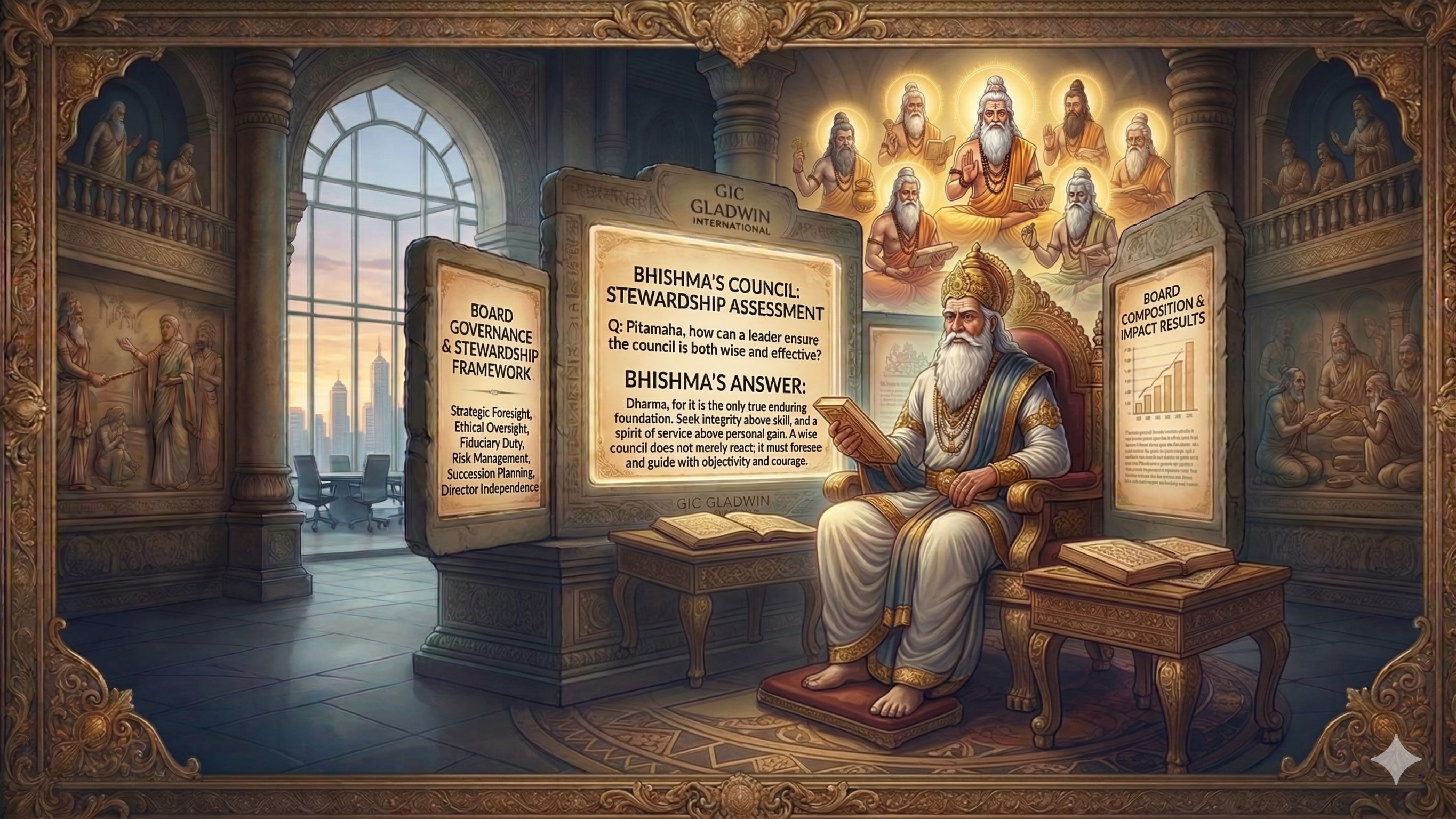
The Artwork — Bhishma presides at the Kuru Rajasabha — the Board Governance Framework displayed before him, the Non-Executive Director Assessment Criteria on the central panel. He was the conscience of the kingdom when the king could not be. He could not stop the war. He could not override Dhritarashtra's failures. But without him, there would have been no kingdom left to fight over. The great NED is Bhishma: the one who holds the structure together when the executive falters.
Bhishma took the most consequential oath in the Mahabharata before he was twenty — to remain celibate, to place the Kuru kingdom's interest above his own life and happiness, and to serve the throne regardless of who sat upon it. For decades he was the most powerful man in the kingdom, and he used that power entirely in the kingdom's service. He could not be king. He chose to be the governance architecture that made the kingdom governable. The great Non-Executive Director is Bhishma.
Bhishma — born Devavrata, son of Ganga and Shantanu — took his terrible vow not to obtain power but to enable power: to allow his father to marry Satyavati by renouncing his claim to the throne and pledging to serve whoever sat upon it. He gave up everything a royal heir expected to possess. In exchange, he received something rarer: the institutional authority of the disinterested guardian. For three generations of Kuru kings — none of them adequate, some of them actively destructive — Bhishma held the kingdom's governance structure together by the sheer force of his presence, his dharma, and his willingness to remain when every honourable instinct told him to leave.
Bhishma's deepest governance failure — and the Mahabharata is unflinching about it — was his silence at Draupadi's humiliation. He was the most powerful person in the hall. He knew the dharma. He could see that what was happening was wrong — that the dice game was corrupt, that Draupadi's dishonour was a constitutional crisis, that Duryodhana's behaviour threatened the entire moral fabric of the kingdom. He remained silent. He later told Draupadi that he was bound by his obligation to the throne, that he was, in a sense, the paid servant of the Kaurava treasury. His conscience and his institutional role were in irreconcilable conflict — and he chose his institutional role. The war was, in part, the consequence of that choice.
This is the most important governance lesson in the Mahabharata for the modern Non-Executive Director: independence is not a procedural matter. It is a personal one. Bhishma was procedurally independent — he had no financial stake in Duryodhana's decisions, no personal agenda that Draupadi's humiliation served. But he was institutionally captured: decades of loyalty to the throne, personal affection for the Kaurava princes, and the social weight of his vow had made it psychologically impossible for him to do what his conscience told him was right. The great NED understands that the governance crisis is always the one where being independent is most costly — and that is precisely the moment when independence is most required.
Lying on his bed of arrows after the war — mortally wounded, waiting for the auspicious moment to die — Bhishma delivered the Shanti Parva and Anushasana Parva: the most comprehensive treatises on statecraft, governance, ethics, and Rajadharma in the entire Mahabharata. He gave the kingdom, through Yudhishthira, everything it needed to govern well — the frameworks, the principles, the case studies, the warnings. He could not give this knowledge while he was serving the king. He gave it at the moment of his complete independence from institutional obligation. This is, perhaps, the deepest truth of Bhishma's board wisdom: the greatest governance counsel is often delivered only when the advisor has nothing left to lose.
राजा धर्मस्य कारणम् । धर्मो राज्यस्य कारणम् । तस्माद् राजा धर्ममेव पालयेत् ॥
Raajaa dharmasya kaaranam, dharmo raajyasya kaaranam, tasmaad raajaa dharmam eva paaalayet.
“The king is the cause of dharma; dharma is the cause of the kingdom. Therefore the king must uphold dharma above all else.”
— Bhishma — Mahabharata, Shanti Parva (Rajadharma Anushasana)
The Four Pillars That Define the Great Board & Non-Executive Directors
The Disinterested Guardian
Bhishma's governance authority derived entirely from his disinterestedness. He had no personal stake in who sat on the throne. He had no children, no dynasty, no political faction, no financial interest in any particular outcome. He served the institution — the Kuru kingdom — not the incumbent. This disinterestedness was not natural; it was the product of his vow, renewed constantly over decades in the face of enormous pressure to take sides. It was this quality — the ability to serve the throne while being independent of its occupant — that made him the indispensable governance anchor of the Kuru state.
The great Non-Executive Director's value to the board is precisely proportional to their independence from management — not procedural independence (which is achieved by meeting the Companies Act criteria and ticking the corporate governance boxes) but substantive independence: the ability to form judgments about strategy, risk, and leadership quality that are not coloured by social obligation to the CEO, gratitude for the appointment, or discomfort with conflict. The NED who has served on the board for fifteen years and cannot remember the last time they challenged the executive team is not Bhishma. They are the silence at Draupadi's humiliation.
Holding the Structure When the Executive Falters
For the entirety of Dhritarashtra's reign, the kingdom's survival depended not on the king — who was blind, emotionally compromised, and fundamentally unable to make the governance decisions his role required — but on the institutions and individuals who held the structure together despite the king's failures. Bhishma was the primary such institution. He could not replace Dhritarashtra. He could not override his decisions. He could only hold the constitutional framework stable enough that the kingdom continued to function, continued to be governable, continued to offer the possibility of better governance in the future.
The Non-Executive Director's most critical governance function is activated precisely when executive leadership is under stress: when the CEO is making decisions under pressure that their judgment would not support in calmer circumstances; when the founding team's emotional investment in a strategy is preventing them from seeing that the strategy has failed; when the organisation is facing a crisis that requires the board to distinguish clearly between supporting management and colluding with management's errors. The NED who is only engaged when the executive is performing well has not yet been tested. The test is always the Dhritarashtra moment: when the executive is failing, and the NED must decide how much governance authority to exercise.
The Conscience That Cannot Be Silenced
Bhishma's silence at Draupadi's humiliation is the Mahabharata's great governance failure — and the text presents it as such, with full clarity about its consequences. But the same text also records that Bhishma never stopped speaking the truth about dharma in every other context: advising kings, settling disputes, teaching princes, warning Dhritarashtra repeatedly about the consequences of his indulgence of Duryodhana. His silence on one occasion does not diminish the pattern of his governance commitment. The Mahabharata asks us to hold both truths simultaneously: that Bhishma was the Kuru kingdom's greatest governance conscience, and that he failed at the governance moment that mattered most.
The great NED is the board's conscience — the one who asks the question that everyone in the room has already thought of but decided not to ask; who names the risk embedded in the acquisition that the CEO is presenting with visible enthusiasm; who raises the related-party transaction that the executive team has disclosed technically but not substantively. This role requires a quality that is rarer than intelligence or experience: the willingness to be unpopular in a room of peers, repeatedly, in service of a governance function that most people in that room would prefer not to be exercised. The NED who has never made the CEO uncomfortable has not discharged their governance obligation.
The Rajadharma of the Arrow Bed
Bhishma's greatest governance contribution came after he had lost everything — lying wounded on a bed of arrows, waiting to die, with no institutional obligation remaining, no political allegiance to maintain, no personal position to protect. In that state of total freedom, he delivered the Shanti Parva: the most comprehensive, most honest, most practically useful governance framework in the Mahabharata. He could say things from the arrow bed that he could never have said from the throne. The governance truth he held for decades, constrained by his institutional role, he delivered completely at the moment of his complete independence.
The great Non-Executive Director's governance contribution is most fully realised when they have accumulated enough institutional standing — enough board credibility, enough demonstrated competence, enough trust from the executive team — that they can speak the governance truth without being dismissed. Building this standing takes years. It requires demonstrated value in the good times, so that the difficult judgment in the bad times is heard as wisdom rather than interference. The NED who arrives at the board with a governance mandate but without earned credibility will say the right things and be ignored. The NED who has built the Bhishma standing — slowly, consistently, through demonstrated integrity and demonstrated competence — will be heard even on the arrow bed.
How We Search for Your Board & Non-Executive Directors
Gladwin International's Board & Non-Executive Director practice is built on a conviction that the Indian boardroom is at an inflection point: the era of the ceremonial NED — the distinguished name on the letterhead who attends four meetings a year and defers to the promoter on every substantive question — is ending, driven by regulatory pressure, institutional investor expectations, and the increasing complexity of the governance challenges that boards must navigate. The organisations that will govern themselves well through the next decade are the ones that appoint NEDs with the Bhishma qualities: substantive independence, domain expertise that genuinely complements the executive team's blind spots, the governance courage to exercise the board's authority when executive judgment is insufficient, and the institutional commitment to build board credibility over time rather than extract board prestige immediately. When Gladwin International conducts a board search, our central question is always: does this candidate have something important to contribute that the board currently lacks — and will they contribute it even when it is unwelcome? The answer to both questions must be yes.
The board that appoints Bhishma does not get a comfortable ally for the management team. It gets the governance conscience that the organisation needs but management will sometimes find difficult. It gets the one who holds the structure together when the executive falters, who names the risk that management is too invested to see, who asks the question that protects the organisation's long-term interest at the cost of short-term convenience. Every organisation will have its Dhritarashtra moments — moments when executive leadership is compromised, when the governance framework is tested, when the difference between a board that functions and a board that merely meets is made visible. In those moments, the organisation needs Bhishma on its board. That is the Non-Executive Director Gladwin International will find for you.
Begin Your Board & Non-Executive Directors Search
Every great Board & Non-Executive Directors search starts with a conversation. Speak with our practice lead — confidentially, without obligation.